Wednesday, July 27, 2011

Busan Journal, End of the Dream -- Almost

Almost Home


We have been back in the US for nearly a month and home for a few days here and there, six days total.  The rest of the time we have been traveling, first in New England and now for the last week in Pennsylvania and Virginia.

During the few days we spent in Houghton unpacking and sorting and repacking, we have seen deer wander across our back yard.  The picture above was a near miss of twin fawns and their mother, who surprised us. I scrambled to get my camera. Mama deer had disappeared over the bank into the woods before I got the camera ready. 

Our time in New England was spent mostly in Maine, where the pictures below were taken.  Maine usually brings to mind pine forests and rocky coast lines, lobsters and sailing boats. These pictures are of a harbor just north of Kittery, Maine, where we had met our son Ian and his wife, Kristen, for lunch.


Yes, the sky and the water really are that blue.  And, yes, we smiled for the camera for those who like people in pictures.


My T-shirt reads "Wicked Big Sox Fan" just in case you can't read the tiny print. "Wicked" is characteristic New England adjective meant to intensify the noun that follows, after the manner of "very."  "Sox," of course, means the Boston Red Sox, a major league baseball team and a New England obsession. The "Sox fan" designation is crucial to clarify loyalties, especially since the New York license plates on our car might suggest "Yankee fan" instead.

I add here parenthetically that my wife claims to be a Yankee fan although she does not follow baseball.  Her loyalty can be traced to her father, who was a Yankee fan of the "rabid" sort, another American adjective that both intensifies and colors the noun that follows.  "Rabid" indicates not only close support of the favored team but also necessary hatred of its close rivals. Further explanation makes for interesting story-telling, but it tends to raise more questions than it answers.

Most of our time in Maine was not spent at seaside, however; it was spent at Whitney Pond, a small lake with few boats and at least two resident loons.


I do not have photographs of the loons handy as they are "shy" birds that are more at home swimming for food underwater than either flying or trying to walk on land.  Photographing them takes more patience than I have had to date, as they will appear suddenly on the surface of the water looking very duck-like and then disappear just as suddenly under the surface again.

The lake may look like Golden Pond, the idyllic lake from the movie, but it isn't. This photo was taken from the little beach just after the sun went down behind the trees.

A week later, the morning  I was packing the car to travel south to Virginia, this yearling wandered into the side yard to chew on a bush near me.


She waited for me to get my camera and snap a few pictures -- undisturbed by my movements -- before she wandered off to graze on other things.

Apart from the traveling since we have been home, and apart from sleep issues we will attribute to jet lag, our readjustment to American life has been seamless. We had the same sense of seamlessness (again, with jet-lag issues) in December when we returned home after four months in England.

I suppose this seamlessness is all to the good, but I do find it a little unsettling simply because our experiences overseas were so good, so positive.  I must say that I am determined not to let our travels, in Korea, especially, slip away too fast. 

For that reason, I will continue to keep this blog going a bit longer, if only to recount some of our experiences and impressions before time bleaches them away.

Friday, June 24, 2011

Busan Journal, Day 28

So -- that's it, I guess!

When I meet someone, and especially when I meet several people at a time, I often have trouble remembering names. Faces usually fix themselves easily in my brain, but names slide around, disappear.  It's sad, but true.

Consequently, learning several classes worth of new student names each semester is a challenge. 

Over the years, I have learned how to make the process easier, but it is always a struggle.  Picture rosters have helped a great deal.

This semester the task has been particularly difficult as the students in my classes are all Korean and the roster is printed in hangul. No pictures. It's not that Korean names are especially difficult in and of themselves; it's that there are so many names that sound similar to dull American ears.


Those dull ears would be mine.

Still, over the weeks I learned to attach the correct name to a student most of the time. As always happens, one or two student names remain elusive.

Now the semester is over, and I have turned in grades. I tried hard to be sure that each name received the grade it was supposed to receive.

I have realized in the two weeks since our last classes that I really need to get better, not so much at learning names as at saying goodbye.

Odd as it may seem, when it comes to saying goodbye at the end of a semester, I find myself feeling awkward and shy, as I often felt growing up.  It is always that way for me.

It is a most unfortunate character trait, particularly regrettable in this present instance when my short tenure combined with our mutual struggles to get to know each other make the goodbye a significant moment. Things worked out well for my graduate class because my students took us to lunch after the final session, as is the tradition here at PNU.

There is no such tradition for the undergraduate classes.  Consequently, in my usual way, I let the moment slip by without the attention it deserved.  We had spent the last class in a review session for the final, and as different groups of students finished at different times, I dismissed them by groups.


At the end, a small group remained, eager to chat.  I dug out my camera and took their picture.  I had actually intended to take a picture of the entire class, but that intention had been forgotten somehow as I visited study groups.


Thank you to these five for making our "goodbye" significant.  To the other two-thirds of the undergraduate (Immigrant Literature) class, my apologies.  It was a great experience.  I had fun and I learned a lot.  I will miss you all.

And some day soon, because of my experience with you, I would like to return and teach more classes at PNU.

For now, however, I have packing to do and more posts to write about Busan, so I will just leave you with a heartfelt kamsamnida!


Later, dudes!

Sunday, June 12, 2011

Busan Journal, Day 27

The Neighborhood


The morning after we arrived at Ungbikwan, our dorm condominium, we took a walk around the campus to orient ourselves.  Important as it was to walk the campus, the walk itself was disorienting.  We did a lot of circular wandering.

It did not help that it was graduation day, so a great many of the people on campus were visitors who had little more idea of where things were located than we did.  Even without the language barrier asking for help would have been a problem.

All we knew about campus, our new neighborhood, as we walked was that our dorm sits at the top of the hill. So, when it was time to go "home" we were confident we could get there by heading uphill.  Easy enough to remember, although the climb remains, well, a climb.

Looking for places, the Humanities Building, for example, was difficult in part because many buildings have a similar look and because signs are in Korean. English names do appear below many hangul letters, but they are often small, frequently puzzling, and occasionally hard to find.

On the way back up to our dorm that first day, I noticed a traditional tile roof partially hidden in the trees a hundred feet off the road.  Both the location of the roof and several other details led me to think it might be a Buddhist temple or shrine.  I remarked that we would need to walk down the path to see what was there in the next day or so.


Last week I decided to the time had come so I walked down the little path.  Sure enough, beside the building with the traditional roof was a ten foot stone Buddha and, behind it, a garden.

So my initial suspicions were confirmed, but what surprised me was the eating area above the shrine.  It is similar to the outdoor eating areas one finds all over these hills. All this time I had thought there must be a trail head onto the mountain, but all this time people were just coming to eat.


I did not go all the way down into the eating area, because that usually draws out the proprietors, the women who run these eating houses, to greet you -- even if you are only passing through.  More than that, however, I wanted to get closer to the shrine since there was no access from the path I was on.

Further down the road from my dorm are steep stairs that lead into a residential neighborhood.  Many students go up and down these stairs, but I had never done so. I went down thinking it would give me access to the shrine.

At the bottom of the stairs, just 150 feet from the sidewalk at the edge of campus that I know so well now is a different world -- small houses, tall apartments, well-tended gardens, and narrow streets.


Getting to the shrine was not as straightforward as I had anticipated, but eventually I got there.  It is not as public a place as I thought it might be.  The buildings were all closed up and there were no signs that visitors were encouraged. The pilgrims I had seen were not pilgrims after all, just hungry souls looking for a meal, a conversation, and a bit of relaxation.

Turns out not to be a big find, but at least it is no longer like so many other places I always intended to visit but never did.


Sunday, June 5, 2011

Busan Journal, Day 26

The Rewards of Teaching

One of the rewarding elements of teaching in Korea is hearing from students who have connected with our reading or discussions in significant ways. That is, I suppose, always the rewarding part of teaching -- to see the light of understanding in student faces and to hear excitement in their voices.


My Korean students have rewarded me many times in this way.

After class a week ago one of my graduate students, whom I will call Mi-Won, mentioned to me what she had found so compelling about No-No Boy, the novel by John Okada that we had just finished discussing.  Interestingly, it was not the central character that she related to but his mother, whose role in the novel embodies a particular set of attitudes and characteristics.  She is an immigrant who, like much of the Japanese immigrant community, hopes to recreate the old country in the new. In this story she believes she can remain Japanese and raise her sons as Japanese.  Her dream is to return to Japan, with her family, as rich people who can live the life of the wealthy -- once the family has made its fortune in America.

Having lived for a number of years in both England and the United States as her own children were growing up, Mi-Won found the mother's plight both understandable and sympathetic in a way the rest of us had not. Mi-Won identified; she found a level of empathy that opened the story to her in a compelling way.


While the portrait in the novel treated the mother with dignity and sympathy, it also portrayed her as stubborn, aggressive, and enigmatic. The Japan she idealized and desired for her boys had been destroyed.


Mi-Won told of her own struggles to raise her children with a  Korean identity, even as they were being shaped by the English and then American cultures.  Her efforts led to misunderstandings and arguments with her son -- she arguing in Korean, he responding in English, using British and American vulgarities.  Mi-Won resonates with the mother's frustrations and sense of powerlessness as she loses her own children to their new culture.

Mi-Won's moments of illumination are what literature is all about.  And in the best of circumstances, those moments are what teaching is about too.

Thursday, May 26, 2011

Busan Journal, Day 25


The Total Animal Soup of Time, Part II

Somehow the semester is nearly done.

Just yesterday I was wondering how to introduce "Howl" to students I did not know, who had no frame of reference for what I hoped to teach and brought unknown expectations of their foreign professor.  I was also wondering how well my new students would read English and understand my rapid-fire lectures.

Now we are finishing our last books and thinking about the final assessment.


On the first day of classes I worked hard to discover what my expectations should be so that I could attempt to bridge the gaps.  That first day the classes were quite big -- not the hundred I might have had in one classroom, but big enough. More significantly, I had no solution to the problem of getting affordable books in English, so my reading lists were tentative. I needed quite a bit of specific information quickly, but I was not sure how to get it.

Getting Korean students to talk, as a general rule, is quite difficult; most of them are accustomed to sitting without speaking in the classroom.The general idea is that the teacher lectures and students take notes.  It is, I suppose, flattering to think that I might have so much valuable information stored up. But all the same I prefer give and take.  My internal GPS functions on eye contact and body language, both of which Korean students have learned to keep under control.

By the second week, the classes were smaller.  I think some students, who were initially curious about the foreign professor, felt the work would be too hard or that there would be too much reading in English. Some may have found the prospect of facing me every week to be a bit daunting.  Perhaps it is true that I am intimidating, although the notion always strikes me as misplaced.

I was sorry to lose so many right off because I have been excited about the learning opportunities.  My learning opportunities, that is.

Whatever the reasons, it has been better with smaller classes -- fourteen in the undergraduate class on immigrant literature and nine in the graduate class on the literature of rebellion.  We have, at least in the graduate class, reached a point where interaction during class is common and fairly easy. I do not exactly teach through discussion, as is my preference, but we come close.


It is the graduate class where we used "Howl" as our first reading. That was a bit of chutzpah on my part, I suppose, but the choice actually worked well.  We spent a lot of time on "Howl."

It was not so much the objectionable stuff that concerned my students -- or me, after my initial what-have-I done!  Every language has its dirty words and every culture has its provocative behaviors, so these elements were not an obstacle to learning.  In fact, these things are part of a fabric of puzzling references and allusions that needed context and explanation, and the form of the poem can be dizzying.  All of this meant I had to approach the poem by explaining context and form. 


As Ginsberg graphically parades nearly every major American concern of the 1950s, I was free to discuss the historical circumstances that made the literature of rebellion necessary. As he speaks the unspeakable and reveals the hidden, we were in open territory.  In the process, the poem begins to make a great deal of sense. It becomes a map of the post-war American subconscious.

The undergraduate class has proven a different sort of challenge.  Part of that challenge is due to the size of the room;  there are fifteen of us in a lecture hall with 100 seats and with a raised stage for the professor. What this has meant is that the natural gaps are emphasized. It is more difficult to create the atmosphere of familiarity in which a Korean student might be encouraged to look up and, dare I think it, speak.


Now, as I have said, the semester is nearly gone.  We have reached the "end game" in both classes.  How shall we draw our studies to satisfactory conclusions?

In the Immigrant class we have finished our books and have begun what I call "ruining movies." We are watching The Joy Luck Club together over a period of three classes with suitable time before and after the segments for discussion.  I am  ruining this movie for my class both because the story is ideal for our topic and because it gives them time to write their final paper without the pressure of new reading for class.

The graduate class came over for lunch this week to see how the foreign professor lives, to meet his wife, and to enjoy a taste of American hospitality.  We had a good time.  We have reached a good point in this learning experience.


Too bad we are reaching the end.  If only we had world enough and time.

Monday, May 23, 2011

Busan Journal, Day 24

Black Goat Food Village

Saturday afternoon Professor Kim, who teaches Chinese Literature, picked us up at our dorm to take us to a "garden restaurant" on Geumgang Mountain.  In the sunlight his car reveals shades of deep purple like a concord grape.

We picked up his wife and three small sons at their apartment building and then headed out.

As he lives at the foot of Geumgang Mountain, we drove quickly out of the city proper, up into the mountain on a two lane switch-back road. No more than ten minutes later we reached a portion of the Geumjeongsanseong Fortress wall that is being rebuilt over the roadway to allow foot traffic on top of the wall and car traffic through it. The fortress itself dates back more than three hundred years, intended as protection again Japanese invasions.


Once through the gate we turned off the paved road. We drove along a wide hiking trail that was in places smooth and hard as if paved, in places rough with large irregular paving stones, and in places rutted and in need of repair. We bounced along to the delight of Kim's young boys, sharing the path with hikers and bicycles.  


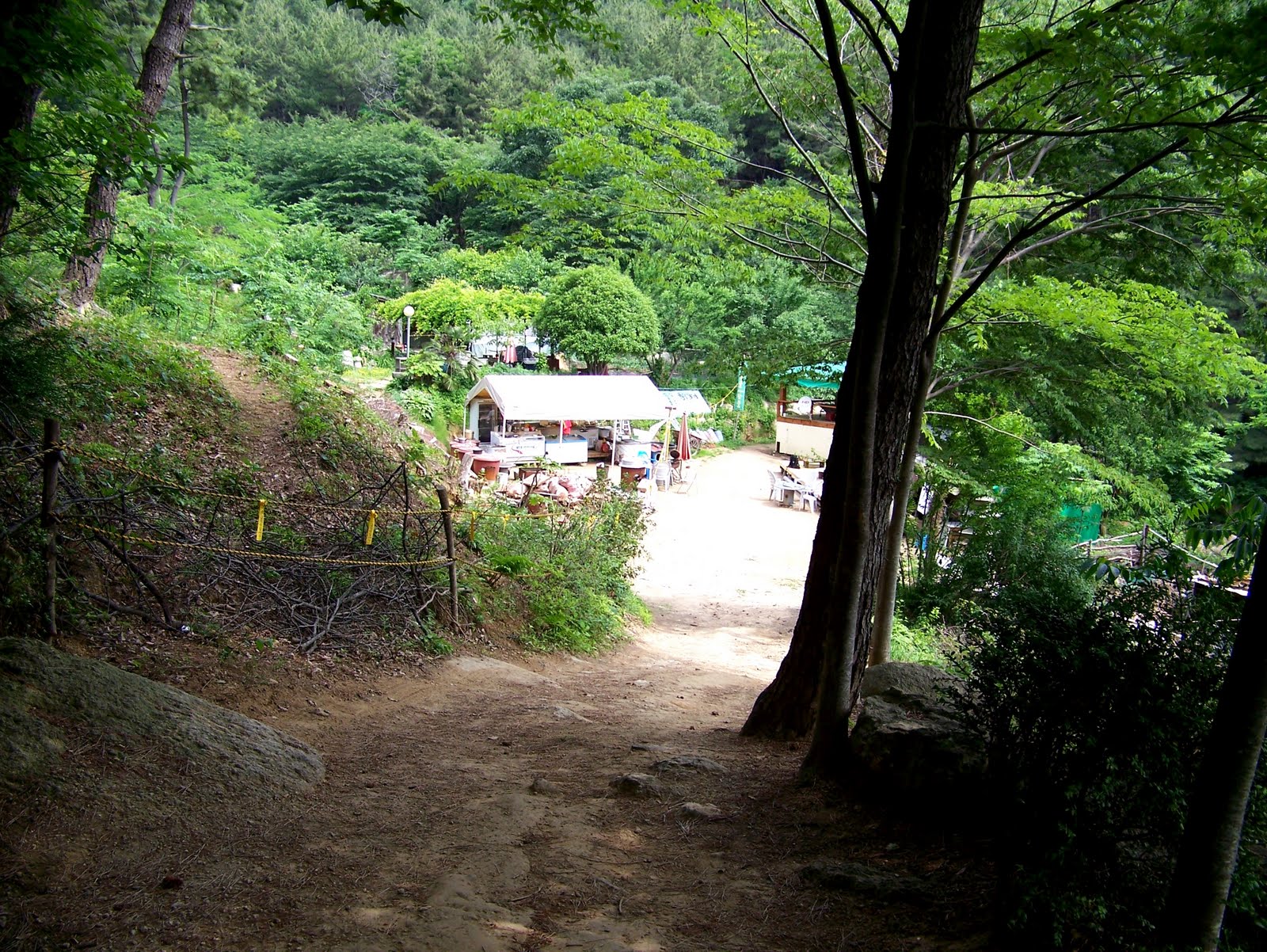
Ten minutes along this trail we pulled off at the garden restaurant. There were six or seven  outlying huts and a kitchen building with a traditional tiled roof and walls made partly of wood and partly of cinder block.The huts have clear plastic walls, galvanized pipe supports, and canvas roofs like tents. Although they look temporary, they are clearly permanent; they are built on concrete slabs, with the pipe framework embedded in the concrete.


It reminded me of a restaurant our travel group visited in Russia in 2004 somewhere off the hi-way between Moscow and Vladimir, although the resemblance is mostly in the feel and look of the place rather than in the particulars.

As usual, we were the only non-Koreans in the area.


Professor Kim parked in a space between huts, near a large mound of discarded wood scraps and cinder blocks and just down from a vegetable garden.   He had called ahead to order our meal and to tell them that Americans were coming. I am sure the "heads up" was appreciated.  They were expecting us.  The duck was being cooked. 

We were greeted -- Ahn-yeong-ha-seo! -- and welcomed into one of the eating rooms in the kitchen building.

Many of the huts had groups or couples eating. There were, as well, several platforms out under the trees where people already eating and relaxing.


We enjoyed eating with Prof. Kim and his family.  His two older boys were mostly out of the room, running around with young children from other huts. They entertained themselves finding worms and insects and watching water work its way down the drive. 


Our room was covered -- ceiling, walls, and floor -- with linoleum.  It was free of decoration and clutter.  Apart from two extra tables folded against the wall, the room was devoted to eating -- one low table and cushions for sitting.


Our menu was duck and goat.  I think Korean meals are identified by the meat dishes, since there are always many small side dishes that may present a variety of special foods but always include kimchi.  To my memory I have not had duck since I was a boy and we once ate ducks my father had shot.  If it were not for the unpleasant memory of helping to pluck the ducks, I would probably not remember eating duck at all.  

And we have never had goat, to my knowledge.  Both were good. Because the goat was spicy, I am not really sure that I can describe the taste except that it made my lips and tongue burn a little. We ate quite a lot.


At the end of our meal we were served rice soup made from the duck broth.  By this time we could hear recorded music coming from one of the huts.  Pop music alone at first and then singing. Professor Kim said that they were singing pop songs that people his age would recognize.  A national pastime, this singing.

The voices we heard came from three older men who were belting out tunes in a hut by themselves, on a microphone, reading lyrics from a TV screen set up in the corner.  A dozen or more empty green bottles lay about the floor.


After we had finished with the duck and goat and acorn moo, we walked with Professor Kim up to the restored West Gate of the Fortress Wall.  The Fortess is a story in itself.  


When our walk was finished, we drove the switchbacks back into what has become our city, feeling full and a bit sleepy.  It was a good afternoon, thanks to Professor Kim and his sweet wife and his energetic boys.


Although we got near, we did not drive far enough into the mountain to reach the Black Goat Food Village.  I thought I would use the name for my title as it has a certain exotic charm.


Thursday, May 19, 2011

Busan Journal, Day 23

Learning Korean

English is my only language.  It is the air I breathe, so to speak, the water I swim in. My three months in Korea is not producing any fluency in Korean. I had hoped for more.

My experience with other languages has always been rocky.  The terms strange and alien have always characterized my encounters with foreign languages.  Latin in high school, German in college, French in graduate school -- all were and are again mostly Greek to me.

The same is true of the Russian terms we learned in 2004 preparing for our trip to Vladimir.  Please, food, toilet, thank you. Hard to pronounce, impossible to remember, funny sounding when I tried to say them, now lost in the odds-and-ends bin of memory. I remember searching for the right word to say as the opportunity for using it passed and coming up with a German word from my college years.


As we prepared to fly to Korea in February, we made a couple of attempts to begin language study.  Our home stay kids had given us a handful of terms over the years --annyong-haseyo, kamsa hamnida, bop. But I have had a hard time getting other words to stick in my brain. I have been hard pressed to hear words and to see them.


We know that learning languages is easier, relatively speaking, for the young. Sometimes I envy them for this ability.  But I think, too, there must be something in the way the brain is wired that makes language a more natural thing for certain people than for others. My brain seems to be wired to resist language retention. When it comes to absorbing language my brain is duck feathers, teflon.

Or maybe thinking this explanation is just an excuse for not working hard enough at it.

I think that living in a culture is an advantage for learning a language, but it is not foolproof.  I have discovered, for example,  that it is remarkably easy to get by in Korea without actually learning to read or speak or understand. 

That a non-speaker can "get by" is a mixed blessing.  When I go to the Post Office, I can make myself understood well enough to mail whatever I want to mail.  I buy stamps, I fill out customs forms, I mail postcards and packages, I send them off.  Some of what I want is obvious; the rest I can usually convey through pointing, expressive gestures, and occasional mispronounced words. The money system, which looks difficult, is relatively easy to master.


The down side is that I may well be paying for the wrong things, thinking I have sent my letter airmail when in fact it is going by freighter around the Cape of Good Hope. Then too if I can get by without a lot of struggle, where is the motivation for learning the language itself.  It is easier to settle for getting by.

Still, I want to learn.

I have been given lots of advice about the business of learning Korean.  And books on the subject abound.


One book I found boasts that you can teach yourself Korean in 40 minutes. I have read it twice and done the exercises.  It has been helpful, but it would be stretch to say I taught myself Korean.


Still, all is not lost. I have been trying in my own way to absorb Korean.  I can hear words now, some of the time, where before talk had sounded like unbroken strings of language. I have discovered the joy of hearing a word or two I recognize in an overheard conversation. Just this week I heard jik-jin in the middle of an otherwise unintelligible conversation.  

That is, I think, a step in the right direction.  What a thrill!


I have also started practicing the Hangul letters. Amazing what one can do with that little brush. Practicing with the letters has helped me recognize them when I encounter them around me. 


These are little things, I grant you, baby steps you might say.  But then, that's the point where language learning is most productive, isn't it.