Showing posts with label Cairo. Show all posts

Wednesday, July 13, 2022

Egypt -- Jim & Donna's Excellent Adventures, Pt. 20, Bartering with the Pros

     We were not due at the Luxor airport until 4:30, so Nagy brought us to a traditional market for one last cultural exposure (and shopping opportunity). Our van pulled up to an alley entrance that appeared dark because the buildings were close together. The alleyway seemed to be covered with fabric although it may just have been that individual stalls were draped. It looked just like the markets you see in the movies except we seemed to be the only customers, which meant shop keepers, eager to sell something, had no one else to approach.

    Eager is one appropriately descriptive word for the merchants. Persistent is another. What the timid North American tourists thought might be an opportunity to see the market and the wares -- to browse, as it were -- quickly become an exercise in trying to say "No, thank you." Then, just "No!" 

    Several merchants approached me straightaway with items in hand saying, "Don't break my heart."


    [These first two photos and the last are thematic rather than specifically from Luxor on our last afternoon. This street scene is intended to capture donkey cart and the merchant scene is from the Pyramids at Giza.]

    I must confess to feeling more than a bit heartless to turn down every approach despite being told I was breaking hearts. More than once we called to Nagy to step in for help. 

    One merchant was particularly insistent so Nagy told us to wait "over there" while he had what we thought was an animated exchange.We did eventually buy a very nice table cloth, which now adorns our dining room table; somehow Nagy negotiated a workable price for us. 

    Danil and the Friedmans found a few things they had been hunting for, so the market experience was profitable for all of us -- though it may have been tiring for Nagy. 

        My last photo in Egypt is of this drawing we found in a cafe we stopped at on our way to the airport. I thought of Picasso. It was displayed near a row of traditionally dressed men who were sitting against the wall chatting. I thought for a moment of trying to get them in the same frame as the drawing, but decided that would be rude.

    Nagy was prepared to order another lunch for us, but so close to our river cruise lunch we voted for coffee, tea, and soft drinks instead. 

    After this last stop we were dropped at the airport where we said our goodbye's to Nagy, who had become a good and valued friend in the ten days we had known him. Once inside, we underwent three different head-to-toe security screenings -- X-rays of carry-on bags; shoes, belts, coins, phones, laptops, et. al., in little bins on the conveyor belt, and so forth. 

    Before we were able to check our bigger bags I had to open them so an expert in antiquities could check to be sure we were not taking genuinely ancient items out of the country. He ripped open all the tightly wrapped stone objects and the nativity sets, which we then had to re-wrap and repack. So much for the strategic, careful packing we had engineered earlier in the day!

    The antiquities inspector was wearing an ID lanyard that read "Saint Louis Art Museum," so I asked him if he had been in St. Louis. He said he had spent six weeks in St. Louis working with the Egyptian Antiquities Collection housed there. 

    When I asked what he thought of his experience, he said it was "OK." Then he added that St. Louis is as hot as Luxor.

    Air travel back to Toronto for our drive home was, as expected, long and uncomfortable, but full of specific answers to prayer, mostly directed toward border crossings. We arrived in Cairo about 10 p.m. with a layover for the flight to Frankfort at 4:30 a.m. Once in Frankfort we said a quick goodbye to our Canadian team -- Matt, Chandra, and Danil. They had to reconnect in something like 45 minutes, so it was high-fives and run. Our connection was four hours, so we took our time locating our gate, found a place to eat, and tried to stay alert for the boarding call.

    Our specific answers to prayer had everything to do with getting in and out of countries due to enhanced and/or shifting Covid requirements. These never did develop as an issue.


    At the US border, which can be a long, tiring experience, we found we were the only car. The Border Agent asked his three obligatory questions -- Where are you coming from? Where are you going to? and Are you bringing anything in that we need to know about? -- and sent us on our way.

    Actually, I am not sure of his exact wording since we had mostly been awake for the last day and a half, and I just wanted enough clarity of mind to drive back to Houghton. That was its own adventure but the major hurdles had all disappeared. Thanks be to God.

Thursday, June 2, 2022

Egypt -- Jim & Donna's Excellent Adventures, Pt. 3

    Badr City is a city under construction. It has literally been rising from the desert Northeast or Cairo since the Egyptian government approved the idea in 1982. If I understand the numbers correctly, it has a resident population of 160,000 -- a little less than 25% of what it has been designed for. It has and will have medical centers, universities, and industry -- all modern with a modern infrastructure.

    It took about an hour to drive out of Cairo from Dr. Atef's church to the Badr City Wesleyan Church that Houghton Wesleyan has been specifically partnering with. The new highway from Cairo to Badr City is very nice but there is literally nothing to see to either side except sand. Eventually, of course, there will be.

    Having climbed into the van at the end of the Bible School sessions in the late afternoon, we arrived at Badr City in the early evening for a tour of the building before the service that was scheduled for 7:30.


    The shape of the church, the entryway, and the general look of the exterior is imaginable from what has already been constructed. Rebar extending upwards suggest what the planned third floor will look like. Due to government regulations, the third floor and the roof have to be completed before interior improvements can be made. Additionally, regulations specify a fairly tight time frame to compound sequencing regulations, so there is no opportunity to finish off one area before attending the next. The current pressure point is to finish the third floor and roof before doing more with what will be the sanctuary or putting in bathrooms.


The sanctuary floor is a concrete cavern, apart from the immediate area where worship takes place, for which folding chairs, large throw rugs, a wooden stage/platform, and temporary flood lights have been arranged.


A view of the worship space from the unfinished balcony provide a broad view of the area where services are held. We were given seats front row right because we were honored guests. When it was time to get up and speak we had to be watchful of the power cables snaking in from the service panel.


    We were taken up an interior concrete staircase without stair rails that circled an open shaft to see what had been done for the third floor. I might have photographed this feature were it not for the fact that I had to pray urgently that I would not topple down into the pit -- or, worse, find myself somehow unable to move mid-way. Oh, the perils of mission work!


    By now you should have concluded that I did not, in fact, topple down the shaft onto the concrete floor far beneath, but I will confess that the passage up and down was terrifying.


    Pastor Atef was eager to show us what had already been accomplished and what remained to be done, both of which are impressive.

    For the detail nerds among us, like me, most of the construction I observed in Egypt was of the sort seen here -- straightforward brickwork, usually rectangular, with poured concrete support columns of various sizes and shapes.

    This construction method and the fact that much of Egypt gets no rain accounts for the boxlike buildings that can be stacked or lined up in a variety of ways and for the flat roofs. Visible rebar means the building is not yet complete. 

    After our tour, we were driven to the Pastor's home for a quick "facilities break" prior to the evening service.


Our team, less Danil, gathered with Dr. Atef, and our hosts for the requisite photo opportunity. I am not sure where Danil was at this point; but he had rejoined us in time for the church service, so we did not have launch a search.


   Back at the church, I had opportunity to bring specific greetings from Houghton Wesleyan to the Brothers and Sisters in Badr City. It was my first experience with a translator, which was, I imagine, harder on him than on me. I referenced that little anecdote in Matthew 12:46-50 to contextualize my brief comments.

    We sang a number of loud and energetic praise songs in Arabic, we listened to a few other speakers, and we heard selection from the children's choir.


    At the end of the service, we greeted many of the congregation, stood for photographs, and prayed with some before making our way to a local restaurant for a big late night meal. This proved to be the pattern for our stay.

 [Here, right to left, Pastor Kamal, a leader in the Badr City church, Dr. Atef, and his son Martin.]


 I seem to have hit it off particularly well with this little boy, the pastor's son, who seemed to think it cool that I would give him fist bumps. And with his little sisters, who were tickled to pose even late at night for the camera.


    But of course by this time, having hit the ground running, our batteries were on life support. So back to Cairo to the hotel around midnight, where we fell into bed and slept, again, like babies.


Wednesday, June 1, 2022

Egypt -- Jim & Donna's Excellent Adventures, Pt.2

     On our first day in Cairo, after a short night of dreamless sleep, we hit the ground running. That overused phrase, "hit the ground running," took on new meaning for me when I saw a man step off a moving bus in front of us and run four or five steps to stay upright. When I commented on this to our tour guide, she said, "The bus doesn't have stops there. He wanted to get off. It's common."

    So we figuratively hit the ground running. Our whole team, five of us, traveled together, always. Our van took us down increasingly narrow and increasingly crowded streets to visit the Egyptian Bible College, which meets on the third floor of Dr. Atef's church. It is the norm, as far as we were able to discern, for the pastor to live above the church and sometimes for a church related set of activities to take place above the pastor's home on the third floor. In this case, it was the Bible College.

I attempted to photograph many street scenes, most of which came out as a blur of color and melting shapes. This one is not particularly typical because it is blocked off and devoid of human and vehicle traffic. But it is reasonably clear. It is notable for the presence of a mobile police unit on the left hand side, just to the right of the flag. Such units were not uncommon.


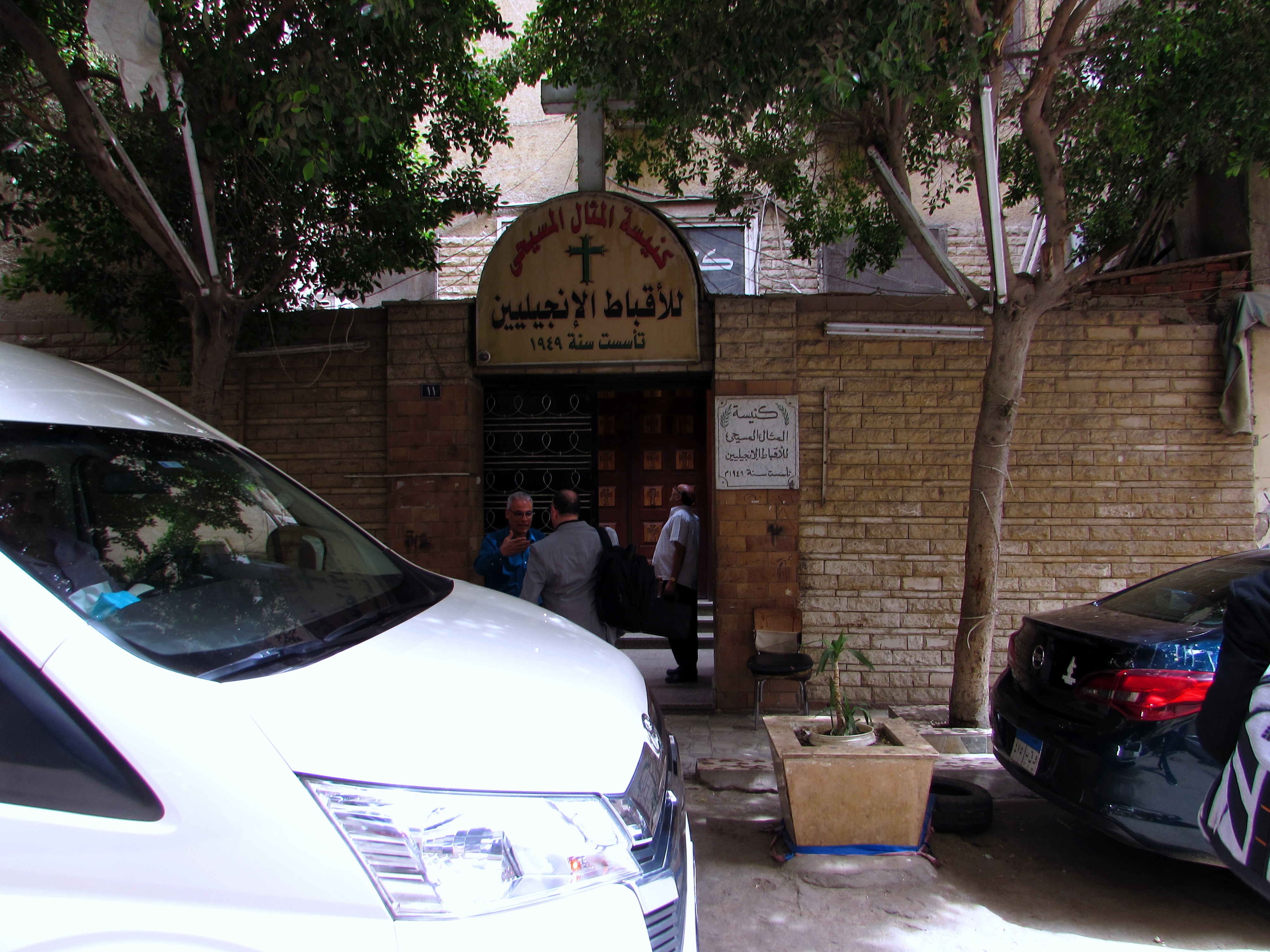
Here is the entryway to the church pastored by Dr. Atef, which is also the location of his home and of the Bible College. Out front are Pastor Kamal, new Superintendent of the Wesleyan Churches in Egypt, Dr. Matthew Friedman, our team leader and Professor from Kingswood University in New Brunswick, and Nagy to the right.


We were greeted by the caretaker of the church and his son, who was entirely unsure what to make of these visitors, especially of the grandfatherly man with the white beard who tried to engage him with smiles and wanted to take his picture.


Before venturing to the third floor for the teaching sessions, we stopped at Dr. Atef's office on the second floor just outside of his home where we presented him and Pastor Kamal with a gift from our church, a vivid reproduction of the watercolor of Houghton Wesleyan by Roselyn Danner. I read for them the inscription expressing our desire for a growing bond between our church in North America and the Egyptian churches.


 Upstairs, Dr. Friedman conducted two hour-long class sessions in this room for Bible College students on the history of world Christianity. We were told that there were a number of students absent because they don't usually hold classes on Friday and these students had other obligations. These students were all pastors, men from various places in Africa and the Middle East. While varying from person to person, their conversational English seemed to be quite good to my ears and their experience both as pastors and with Scripture was extensive.


After a lunch break provided by the staff, I taught for an hour session before Dr. Friedman returned for the last hour. My lecture, which was not sequenced with the other lectures as to specific subject, dealt with Psalm 121. I described a method for using the English text in multiple ways -- as a tool for improving one's English, as a way of using the form and structure of the Psalm for structuring sermons, and so forth -- that I adapted from the first chapter of my book Words That Move Us. [Forgive, please, the shameless self-promotion here.] 

    At the end of the school sessions, it was pressing on 4 p.m., and we got back into the van for the second half of our day -- at Badr City. We had apparently hit the ground in order to keep running!