Thursday, August 8, 2013

China Revisited 2013 [33]

The Big Buddha

Our last day in China was both a day of preparation for our flight back to New York and a day for sight-seeing in Hong Kong.  We said our good-byes to Edward's grandmother and the two maids, who had been so kind and hospitable to these high-maintenance guests, loaded our bags into the van, and headed for the border.

It doesn't take long. There are two border check points, one for China itself and one for Hong Kong. Paperwork needs to be in order, passports ready.  After the second border crossing the van shifted from driving on the right to driving on the left, British style, and we crossed the river onto the islands that comprise Hong Kong.

It was a hazy January day, but even with restricted vision, it is clear that the harbor is extremely busy with all manner of boat traffic.

Our first stop was the airport hotel where we would spend the night in preparation for our early morning flight. Near the airport is a mall with a train station, Tung Chung, where we went next to meet Yujia, who was to arrive from Guangzhou to be with us on our last day. It is always a treat to have Yujia on board.

The mall also houses the cable car terminal for the aerial tours out over the Tung Chung Bay, up and over the hills that form the Lantau North Country Park to Ngong Ping Village, which lies at the base of "The Big Buddha." We tend to think of Hong Kong simply as a congested city, which is true enough, but it also includes forested hills on multiple islands.

Edward booked a "crystal cabin" for us, which meant the cable car had a clear glass bottom. It was both a generous gesture, as these crystal cabins are more expensive, and a bit of teasing since both Donna and I fear heights. Edward took advantage of this knowledge to remind us at every opportunity just how high up we were.

The glass bottom did not concern Edward or Yujia, nor, apparently, Edward's mother. They moved about quite happily, while we held onto the plastic seats.

I offset the effect of riding without visible support just a bit by setting my backpack between my feet to hide the view straight down. It also helped us to look straight out rather than down through the glass floor. For me, at least, once the car was out and away from the platform, I was OK.

 The cable ride is 25 minutes.  About 18 minutes into the ride, after we have crossed the bay and the first set of hills, the Buddah comes into view in the distance.  Because it was hazy, as I said earlier, the statue at first was mostly a dark, ghostly presence in the distance.


As one would expect of a Buddha, it just sits placidly atop the hill at some distance from the cable route.  We disembarked at Ngong Ping Village, which is a new commercial enterprise constructed as a tourist destination. I was surprised to learn that the Big Buddha itself is of recent construction; it was finished in 1996. There is a mix of commercial and religious forces at work here that I cannot entirely disentangle; but my best explanation is that after years of suppressing religious practices, the Chinese authorities have begun to encourage the ancient forms due to their commercial value. They are, in fact, beneficial to the local economy.  I realize as I make this observation that Hong Kong was under British control during the construction of the Buddha and the village. That fact does not dissuade me; I think my explanation is likely close to the truth.

There is a Buddhist monastery in the village to serve the needs of worshipers who come to the temples that are also part of the complex.


We had lunch in the village, but not at Zen Noodles, which had been my suggestion. As near as I can tell we ate at Ngong Ping Garden Restaurant.  I have eliminated most of the other possibilities -- Starbucks, Subway, Zen Tiawanese Bistro, da dolce Gelato Italiano -- you get the idea.

The village itself is basically one street of stores that head through a set of gates toward the Po Lin Monastery and the hill dominated by the Big Buddha. The Monastery is separated a distance from the shopping district by a stone-paved pathway lined with figures of historic generals whose deeds in battle have legendary status. The shrines in front of the monastery were filled with people burning incense.  Smoke and ashes were everywhere.


The Monastery itself is beautifully kept. Clearly the commercial prosperity of the new village has allowed the Monastery itself to prosper and, in turn, to serve as an colorful display of ancient art and architecture. The detail in these traditional styles is quite astonishing.  I am personally attracted to the little animals that one finds along the roof ridges, which were reminiscent for me of similar traditional styles in Korea.


After we had looked at the Monastery, we climbed the stairway to get a closer look at the Big Buddha -- 15 separate sets of 14 steps, or, 210 steps altogether. There are a few more steps at the top if one wants to pay a separate admission to get up close and personal with the Buddha itself, but we all thought 210 steps was plenty.


My impression was that few people, maybe just the seriously devout, actually paid the separate admission. Most settled for the 210 steps.  There was actually quite a bit to see from that vantage point. In the little rooms beneath Buddha's platform was a set of large room that had information about Buddhism, photographs and diagrams about the construction of the Big Buddha itself, and items for sale to help you remember your trip.

 At the bottom of the 210 steps again we stopped for a snack of tofu pudding in an eating hut that also reminded me of Korea -- plastic hung walls, outdoor cooking.  The tofu pudding was good although I don't have any memory of the exact taste.

Then, having seen the Big Buddha, we checked to see where in the world we were -- a mere 13,000 km from New York -- before we boarded our crystal cabin for the ride back to Tung Chung, Hong Kong.


Wednesday, July 31, 2013

China Revisited -- 2013 [32]

Splendid China, part 2


Scale is often an issue for a foreigner in China. How does one imagine size and distance, for example?  How does one understand engineering, even with a knowledge of physics, a comprehension of mathematics, and an appreciation for architectural beauty? How does one understand weight and balance, motivation and vision, the costs of human labor?

Splendid China does not answer those questions, of course, but it provided for us a beginning, a point of reference; in short, a way to imagine the unimaginable.

The Great Wall, which runs for hundreds of miles across northern China and is one of the few ancient human structures visible from space, is one illuminating point of reference.  To see it in miniature run for hundreds of yards as a replica frees the imagination, even against the backdrop of modern Shenzhen, which is a product of Deng Xiaoping's vision in the early post-Mao era. One is prompted to think of the Great Wall as "the glory that was China." That is fair enough, but one ought not stop there.


It is necessary and helpful in all of these observations to think in terms of people as well as engineering, to think of citizens as well as emperors, to think of laborers as well as engineers and architects. The little costumed figures on the terraces and stairways allow the tourist to do that; they offer a human dimension that provides perspective both in terms of scale and of human activity.

In this regard, nothing is quite so moving as the model of central Beijing leading from the Temple of Heaven north to the Forbidden City. The actual structures, dating from the early 15th Century, were, among other things, designed to demonstrate physically the Emperor's connection to heaven.


The Temple of Heaven, the largest building in the world dedicated to the offering of sacrifices, lies at the southern end of a north/south axis, with the Forbidden City, home to Emperors from 1406 until 1911, at the northern end. The road linking these two complexes is, or was, roughly 4 miles.  The model in Splendid China, built to scale, runs at least a hundred yards from end to end.  In real life, even centuries ago, it would have been hard to see from end to end.  In miniature, that view is not only possible -- the scope of the endeavor itself gives one pause.


Consider also for a moment the fact that the entire route is lined on both sides with people, and not just ordinary people, mind you, important people who were summoned to take their places when the emperor traveled between the Forbidden City and the Temple of Heaven. Judging from the figures in the model, these men are standing roughly an arm's length apart after the fashion of soldiers who space themselves in formation by extending one arm to the shoulder of the next soldier.

 The scale model does not, of course, include extraneous building, which is both good and bad. The fact that there is no way to imagine clearly what Imperial Beijing beyond this axis is a loss. In modern Beijing, too, there are thousands of buildings that clutter this central plan, so the model is deficient in that sense too.


On the other hand, the model allows one to imagine the Imperial grip on Beijing, both in terms of architecture and in terms of power.  Part of the original intention of the first emperor's vision was to create a small model of the cosmos as it was or was intended to be understood. Beijing itself was then built in concentric rings around this central architecture.


What we as Americans know generally of this long complex construction is almost entirely related to what has been preserved of the Forbidden City. The Forbidden City with its 30 foot high red walls, its 800 buildings, and its 178 acres is one third the size of the Temple of Heaven.It required, apparently, a million laborers working steadily for 14 years. There are many facts and details that I need not mention here. But the sheer size and complexity of this endeavor is hard to comprehend even viewed in miniature.

The red wall of the Forbidden City, as everyone knows, is now additionally famous for it huge portrait of Chairman Mao.

But for the outsized gestures like this Mao portrait, the human figures are all but lost against this astonishing achievement.  This is indeed what puts the "splendid" in the name, Splendid China. Almost lost, but for me no less splendid, though in a different way, is the massive physical effort, the hidden human cost, that made this magnificent vision possible.


Thursday, July 25, 2013

China Revisited -- 2013 [31]

Splendid China, part 1

One afternoon between our trip to the village, LuHe, and our days in Guangzhou, Edward told us he would take us to a cultural exhibition in central Shenzhen.

The place is called Splendid China. Were we interested?

Sure. Of course.  That's what we're here for.  Although we had never heard of it, the name is typically Chinese in its use of the grand descriptor "splendid." Splendid in many ways it is.

Splendid China is a new construction, a tourist destination built to show off all parts of China, not specifically the cultural sites of Shenzhen. It was described for us in various ways.  It is an outdoor museum / folk village after the order of Mumford Village (for folks in western New York), though on a vastly larger scale. It is a theme park of recreated places and structures that might make one think of Disney World -- without the fantasy and without the rides.

Well, maybe with a touch of fantasy and rides.

The entry to Splendid China features several huge displays of modern, cartoonish renderings of traditional Chinese things (like dragons) and new Chinese things -- all of which suggest the universal appeal of modern TV animation. Note the characters have "western" rather than Asian eyes.

On our visit to Splendid China, the kissing couple, more traditional and clearly Chinese, was drawing young folks who posed for photographs in front of it. I don't remember seeing too many of those young folks in the park itself, however. To be honest, there weren't many people of any age in the park on that day as the weather was cold and showers threatened.


[We did encounter a group of Korean tourists that we identified by the sound of their conversation. Quite a feat, I must say.  Donna called "Anyounghaseao (hello!)" as their open carriage drove by us.]


Edward parked at the car entrance, in an partially submerged parking garage just beyond an enormous tree that I remember as being a tropical species of sycamore.

The cultural center itself had no other Disney-like characters that I remember, although it did have an aerial tram for those who wanted a seated overview. We chose to spend our visit on foot, all four hours of it, which began with a series of imposing stone archways that lent a more traditional "weight" to the park entrance. We did not have time to visit every corner of the park and we did not see any of the cultural shows that were offered in better weather.


These arches, like nearly everything in the park, were newly constructed replicas rather than old originals; they create the look and feel of an ancient imperial city, although no ancient sites had been scavanged for artifacts. At other displays in the park, as, for example, with the Great Wall reproduction, the model is so vast in its scaled down version as to demand an emotional response. One cannot help but be impressed by this staggering feat of engineering, ingenuity, and physical labor. 


The mission of Splendid China is, objectively speaking, preposterous.  How does one take the mind-boggling variables -- a land mass the size of China, a civilization that spans 5,000 years, and a population that includes 56 ethnic groups -- and adequately represent it in one "theme park"?

To be fair, one could hardly do justice to China's diversity, scale, and longevity even with a life-time of free travel and ready access. Nevertheless, Splendid China accomplishes some significant things.

In an odd way the large and the small replicas, and the presence of floral "representatives,"achieved a sense of "China" that would be hard to create short of the life-long tour I have just suggested.


Perhaps the first conclusion one might draw from these re-creations of the wonders of China is just how varied China actually is. I grew up while China was a very "closed kingdom," imagining China as a land of exotic wonders and drab daily existence -- this was during Mao's early years, after all -- but never in terms of diversity.  I would have thought that the Chinese were uniformly Chinese, with one language, one form of writing, one identifiable look, one mode of dress (sometimes plain, sometimes fancier), one means of living, and so on.

Although much of what was unknown about China in those days is knowable today and while no intelligent westerner would admit to holding the kind of singular view of things Chinese that I just described, the fact remains that we often don't think past the false notion of China as a mono-culture. The truth is -- and the value of a tourist destination like Splendid China is -- that mono-culture idea is quite simply false.

Splendid China will never replace visiting actual cities, countryside, and historical sites, of course; no recreation can. And we will want to see the actual terra cotta figures and the Great Wall on our next visit.

But  Splendid China is, in fact, an efficient way to begin understanding the Chinese complexity.  China is many things: it is mystery, it is confusion, it is contradiction, it is elegance and dignity; it is in many ways overwhelming.  It is a long, significant, complex history. It is many enchanting cultures. It is diverse and fascinating peoples.

But China is not fantasy.

One of the ways that Splendid China is different from a place like Disneyland is that while it creates fantasy it is not really a destination. The fantasy is wanting to see the real thing -- all of it.


Friday, July 19, 2013

China Revisited -- 2013 [30]

Nearing The End

We did not see everyone we had hoped to see on our trip to China.  We did not see Tra, who is Vietnamese and had hoped to travel up from Hanoi.  Nor did we see Frances, who lives in southern China but was unable to travel down to Guangzhou while we were there due to a rare snowstorm that brought transportation to a halt.

But we did see Candy and Vicky, who were home on holiday break from their universities in the States.


Candy is one of our two year home-stay daughters. She is studying at Baruch College in New York City. We met her and her parents for dinner at a gorgeous restaurant near Splendid China in Shenzhen. This photograph is essentially a fish tank built into a wall beneath the restaurant's signature tiles, which are a traditional local feature.

Sadly, I do not have a close-up picture of her for this account, due to the memory card incident that I keep mentioning. Suffice it to say, she has become a beautiful, accomplished young woman. We had met her mother while Candy was an Academy student, but not her father.


Our time with Candy was too short.  The most memorable food item at this restaurant was not actually something served to us.  As we were leaving the eating area and looking both for rest rooms and a setting for group pictures, we were stopped in our tracks by a parade of  uniformed food servers filing out of the kitchen and heading down the hall toward banquet rooms where wedding celebrations were under way.

Each server carried a tray with a whole pig with flashing pink eyes.  The line of servers with pigs kept coming. I estimate at least three dozen of these little porkers flashed past!

Apparently the pig itself is not eaten in this form. What we saw was essentially the outer pig, the skin from snout to corkscrew tail, which I gather is sampled as an appetizer.

One server stopped for Candy to take a picture, as its roasted compatriots processed, flashing and shining, down the hall toward the banquet rooms.


There are no easy transitions from pigs with flashing eyes.  It is a little like speaking after someone who has brought the house down.

On our last night in Shenzhen we had dinner with Vicky and her mother in a restaurant in the community where Edward lives. She was delayed traveling to Edward's house.  The 30 minute drive took two hours due to traffic.


To pass the time Donna and I started playing ping-pong. The sound of the ball on the table must have carried upstairs because soon the younger maid came down to watch. As soon as she appeared, I gave her my paddle. Clearly she was delighted.  She and Donna played with great spirit and much laughter for about 15 minutes before Vicky came.

Among other problems resulting from the drops my camera suffered was the loss of the flash.


Vicky was an Academy classmate of Edward and Yujia.  She lived two doors down from us at the Woodards'. Like them, she is also attending Syracuse University.

This dinner, like the dinner with Candy, was geared toward foreign tastes, so we ate more western style.
Despite that disclaimer, I made note of several gourmet items on the menu: Buddha-jump-over-the-wall soup, which features sea squirt and chicken feet; Braised shredded snake meat with abalone soup, which speaks for itself; Braised wild boar belly in brown sauce; and wok-fried oysters and chicken testicles, an item that wants no comment from me.


During our conversation with Vicky, as we discussed our eating experiences, she informed us, "I do not eat organs."

To our American ears, she seemed to be saying, it's OK to be selective.


Saturday, July 13, 2013

China Revisited -- 2013 [29]

Auspicious Timing

YuSi was the first of our Chinese home stay daughters from the mainland. She followed YatShen, whom we called Janet, also Chinese, but from Hong Kong.  HongKongese, as she would say.

YuSi and Jacky, also a former Houghton Academy student, came to our hotel to pick us up in the afternoon of our visit with Angel's parents. They wanted to take us across the city to YuSi's house and then to dinner.

YuSi's uncle drove the four of us back in the direction of  Chen's Lineage Hall. He was cheerful but quiet. He spoke no English so beyond "Ni Hao" we couldn't talk with him.We did the stop and go thing again at every intersection. Lots of cars and buses. Lots of scooters and panel trucks.  Lots of pedestrians.

We drove first to YuSi's house, which is a fairly new, free-standing house in a gated apartment complex.  Sadly, I did not have a working camera at this point due to the memory card incident. The few pictures I do have were taken on YuSi's iPhone.

YuSi's house is two stories with a basement.  Her father has an acoustically engineered listening room down there where he goes to sit with his eyes closed and take in the music. He is clearly a cultured man, someone I would like a long conversation with another time.  We met him briefly two years ago, although our lack of a common language kept the conversation down. We, too, were on a "Ni Hao" basis, although I might not have known "Ni Hao" at that point.

The upper two floors of the Wu house are modern by any standard, with marble floors, lots of woodwork, high ceilings in the living room, and many pieces of modern art, including a large painting with "peace" written in many languages. By large I mean 6' X 8' or 8'X10'. It doesn't sound all that compelling but it was actually quite striking. A word painting.

In another part of the apartment complex we visited the home of another former Houghton Academy student who had been in Donna's classes, Jack.  He is not to be confused with Jacky, who comes with YuSi. His parents are calligraphers. Artists. Jack was out of the country, a student; but his mother was home.  They are friends of YuSi's parents. She took us into their studio and let us look at the paintings and calligraphy they were working on.

The studio was a large rectangular room with high ceilings, many flat work areas, and dozens of art pieces hung or stacked. Chinese calligraphy is practiced with a vertical brush held over a horizontal surface. I was permitted to try my hand, so I tried out a few Korean letters that I remembered from our days in Busan.

At the end of the afternoon we climbed back into cars with Jack's mother, YuSi's aunt and Jack's cousin who spoke English well from a 10 year stint in Canada. It was after dark when we arrived at the LiWan Lake Park. The park has a number of lakes, ancient banyan trees, weeping willows, exotic flowers, and birds, most of which we were not actually able to see. What we saw mostly were lights, which were beautiful.

We ate at the Panxi Restaurant, which lies along the lake shore. Its 40 eating rooms (many of them huge)  can serve 3,000 customers at one time.  As we walked along a hallway open to the lake on one side, we passed at least 5 wedding celebrations.

Everyone, including brides and bridesmaids, was wearing jackets because of the cold.  What we found amusing was that the bride would pull off her puffy white jacket to pose for a picture or two and then put it right back on.


When we commented about the number of wedding celebrations in one place on one evening, we were told it was an auspicious date, so many had chosen that day for the wedding.

The Panxi is a Cantonese dim sum restaurant. We wore our winter jackets into out private room like everyone else. But we had enough experience by now to know that after a few cups of hot tea and a bit of soup, the body would warm up enough to allow us to take off our jackets.

In addition to its beautiful landscaping and architecture, which we saw mostly in terms of lights, the Panxi is famous for its little animals, especially the dumpling rabbits with carrot bits for eyes and the bread pigs.  You can't do much better than bread pigs.

We also had pig curry, lotus root, and fried chicken with potato chips. Pig curry and lotus root are clear enough, but the fried chicken and potato chips need a point of clarity.  We are not talking KFC and Lays here.

Somewhere between the rabbits and pigs, Yusi and Jackie asked us if we could stay in Guangzhou until January 14th.

As we were to fly back on the 10th and expected to be teaching on the 14th, we said, Sorry, no. What's so special about the 14th?

It was, we were told, an auspicious date. They had chosen that date to get married.

Such good news -- but after six or seven years of dating, why not give some advance warning? We would have found a way to stay for the wedding. Well, we were told, there is no wedding, just a registration with the local authorities.  The celebrations, of which there would be three, would come later, no doubt on other auspicious dates.


Monday, June 17, 2013

China Revisited -- 2013 [28]

Chen's Lineage Hall

Official on-line information for the Chen Clan Academy (one of three names I am aware of) suggests that 45 minutes should be sufficient to see this state protected cultural site.  Forty-five minutes is about what we had for our visit, but rest assured it was only sufficient for a walk through. To see the site will require maybe a week.

Our brief visit to Chen Clan Academy, a.k.a., Chen's Lineage Hall, now renamed Guangdong Folk Arts Museum, was fascinating.  Unlike the ancestral garden compound we would visit the next morning with Angel's parents, this ancestral hall was not built with on-going family habitation in mind; it was built to honor ancestors. And it was used as temporary housing for clan members who came to Guangzhou to take the Imperial civil service exams.

The structures themselves were constructed in the late 19th Century, not old at all by Chinese standards.  It is the art, architecture, and traditional artifacts that bear the stamp of tradition and timelessness.

Briefly, I'll mention the patterns of architectural symmetry that always astonish in China. There are 19 separate buildings in the compound, which is walled to separate it from whatever would have been outside in the 19th Century. The compound is rectangular, 6,400 square meters, facing south. There are 9 main halls, 10 lesser buildings, and many spacious courtyards.

This hallway is just one example of the precise and sometimes breathtaking repetitions that speak of precision and attention to detail. Both are significant. Those characteristics supplement and enhance the traditional meaning(s) of literally every element of the Hall. I hesitate to apply the word "symbolic" because symbolism as a cultural term reduces the way various features might speak to us. Neither statistics nor architectural technicalities nor artistic language can speak separately to this complex construction.

Among the artistic features are various forms of "decorative" detailing. Along the roof ridges and edges and gutter facings we find vividly colored figures that are human and mythical (e.g., the dragon) -- or natural creatures invested with special meaning and power (e.g., the lion).  All of these characters tell stories; that is, they can be "read," although not by me.

So we have human characters with real stories rooted in history; human characters with stories for which "history" is beside the point (think of George Washington and the cherry tree, from which we get the first rule of honesty: I cannot tell a lie, despite the fact that the cherry tree was invented); human stories connected to mythical characters (e.g., dragons) and/or real creatures (lions, frogs, turtles, et cetera); and traditional "symbolism" all over the place.


Pottery is one medium artists work in, wood is another. The story here is told in the branches of what is either a monster vine or a tree with many twisting branches.  We find many things as the branches go up, from birds who naturally roost in trees to humans in tree houses, to the usual assortment of non-human creaturely things.

What knocks you over is the detail, the painstaking and labor-intensive intricate carving that is made to look effortless and graceful and seamless. And, of course, expressively artistic and compositionally balanced. It is not just a question of art and craft that must be mastered, but of massive perseverance -- just staying at it for however long it takes.


These observations apply also to the ivory carvings, like the boat, displayed in a room full of intricate ivory pieces.

The same could be said of brick carving (below) or stone carving.

These are all decorative, although they are not simply decorations in our modern use of that term. The Chinese clearly have understood the value of the many kinds of creative arts for embodying the culture.  What I mean to say here is that "mere" decoration would make things "pretty," a quality Americans have often consigned to the female, as in, this house needs "a woman's touch."


What we find here is not embellishment, although it is embellishment, so much as embodiment.  The decorative arts cannot be separated from the functions of the building; they cannot be removed from the lives of the people who live and work and visit without losing something vital.  That is the chief insufficiency of even the best museum.


The description of brick carving below expresses more eloquently than I could the intellectual energy identified with all these activities.


True enough.  It is all about auspicious patterns and enriching bald walls with various folk arts "used wildly."  I am all about wild uses of art.  In addition to the art already mentioned there were wood carvings, lime carvings, iron castings, frescoes, and various kinds of textiles (especially traditional dresses and robes that would make the pope look shabby).


When our 45 minutes was nearing its end and Lineage Hall officials were (apparently) getting concerned that we would overstay, somebody came to find me.  I may have been grooving on the gardens out back, which have their own explanations, patterns, and exoticisms.  Maybe I am a slow learner, but as they summoned me to the museum shop, where we were encouraged to take our time, I knew that I would like a few more 45 minute visits. Or better yet, I would like the week I mentioned earlier to see all the things I dearly love, like doors.

Monday, June 10, 2013

China Revisited --2013 [27]

Caught in Traffic
or Why We Don't Ride the Subway in Guangzhou

On our way to Guangzhou -- Edward driving and his mother riding shot gun -- I wrote down two signs in English I thought were worth remembering.  One sign on the side of an office building read, "Community Childbearing Culture Center." Donna and I had a long discussion as to what childbearing culture might suggest.

The second was a traffic sign of the "Click it or Ticket" variety we see in New York. It read "Beat Traffic Bandits and Obey Traffic Laws."

So we beat the traffic bandits and obeyed the traffic laws. I am not sure what traffic bandits are, but we did not beat the heavy traffic. Nevertheless, we got to our hotel, the Ritz Carlton, in good shape, and began the cycle of big meals with former students and parents who wanted to express their thanks to Donna for her efforts in teaching their kids.

We met up with Yujia, who had taken the train back to Guangzhou the day before, her parents, April (pictured below, left), and Cynthia (below, next to April). We piled into two or three cars and made our way through considerable traffic from the new part of Guangzhou, where our hotel was located, to the "old" city, where we were to visit a cultural treasure.   It took an hour, more or less, mostly spent merging or waiting for lights to change. My notes record that Edward was "fuming." I don't any longer know what I meant by that.

At one point as we were sitting in traffic making smart comments about getting out to walk (like mother-in-law jokes, these comments transcend cultural barriers), we asked whether there was a subway system in Guangzhou. Surely, we thought, there must be a way to beat the red lights at every intersection and the pedestrians and the merging lane backups.

"Yes, of course Guangzhou has a subway. This is a modern city."

"Do you ever take it?"

"No. Never. It is too crowded and very complicated.  It would take us twice as long to get where we are going."

When we arrived at Chen's Lineage Hall, a huge walled compound similar in outward appearance to YuYin Shan Fang, we met Syan, another former student and frequent visitor at our home, and his mother.


The Hall was only open for another hour -- was it worth going in at all? There was animated conversation in Chinese; then we moved toward the ticket booth. Since we had made the long trip to the old city from the hotel and would have another long trip back, it had been decided we would see what we could see.


Then, when we had rushed through the Hall, which I write about in my next post, we stopped in the Museum store to find some little things to take back to the US. Most of the things that caught my eye were too big (for suitcases), too heavy (stone sculptures, books), too cumbersome (the paintings and calligraphy), too expensive (most of these) or too touristy (trinkets one could find in NY, Hong Kong, London). 

 We settled on postcards and name stamps, which were carved with our initials in both English and an old form of Chinese while we watched.
 
From Chen's Lineage Hall we reentered the traffic to head for dinner at a restaurant owned by Syan's parents.


At dinner we were treated to -- among other things -- rice porridge fondu, pumpkin noodles with sugar and vinegar sauce to give them flavor, bitter melon, and oyster pancakes. We were also served steak after the American fashion, a concession, no doubt, to the western appetite. We also found the tomato rabbit appealing.  Among the signs of respect I noted were a chair with arms (the only one at the table) and a manager's toast in which the manager led his staff to my end of the table and drank to our health.

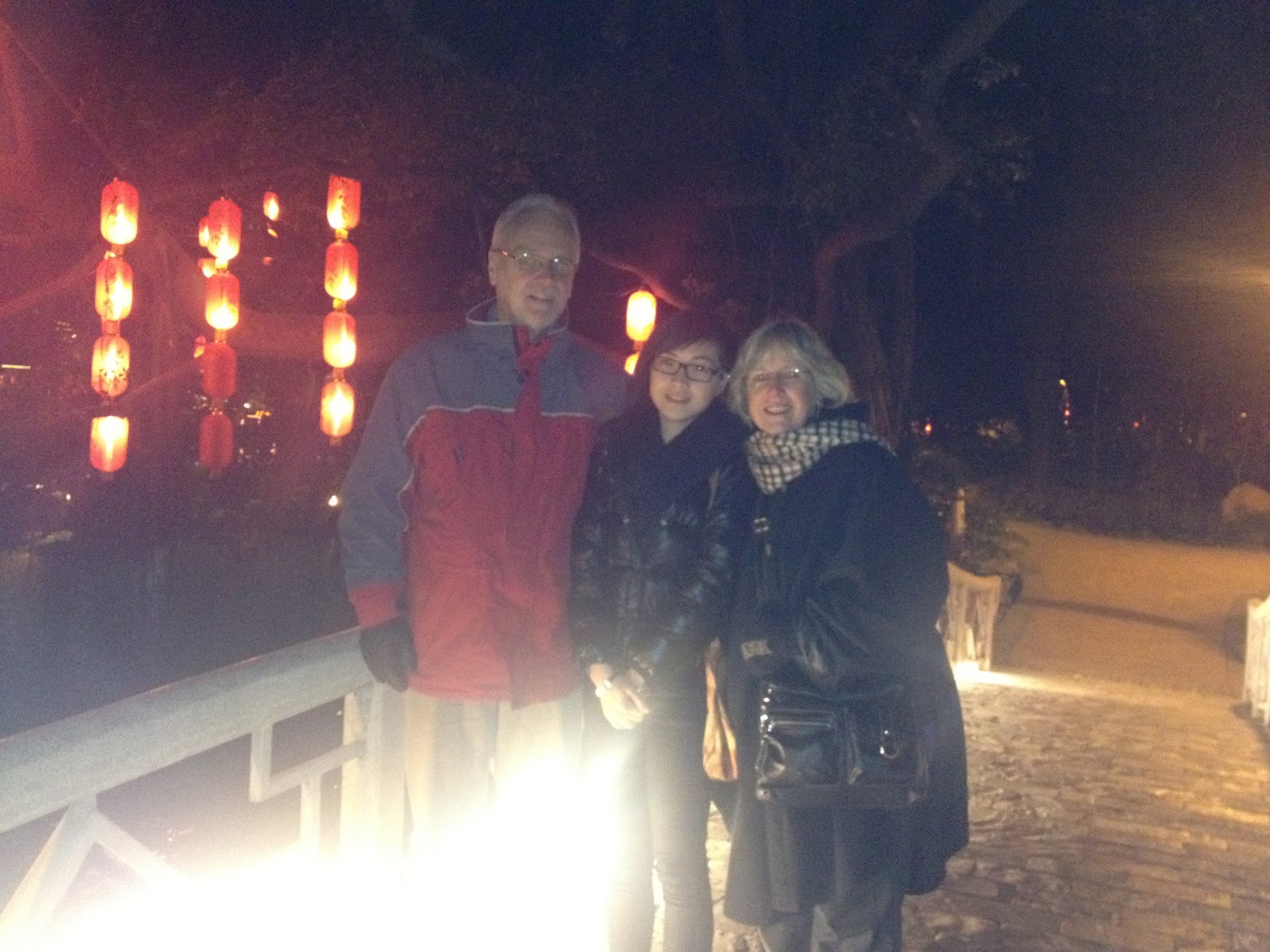
After dinner we went out for a walk near the hotel.  Some of the lighted buildings we had seen on our river cruise in 2011 are visible from the hotel.


We are directly below the pink tower on the left.  As in many cities, new building designs in the Chinese cities we visited incorporate light shows so that an outdoor stroll has an entertainment aspect to it. Even on this cold night in January, we found the square full of people -- couples, families, teenagers, older folks.


At the edge of this plaza where we walked to view these building were three gigantic transformers.  I am guessing that they stood 15 feet high.  They rotated their bodies and moved their arms, sending out colored light beams from different parts of their bodies.

Somehow I had gotten separated from our group, like a child wandering away from the adults to look at the pretty robots.  I wanted a picture for my grandson Toren, who is fascinated by such things. But my camera was already full and my unyielding laptop, not the traffic bandits, still held my memory card.