Showing posts with label Shenzhen. Show all posts

Thursday, July 25, 2013

China Revisited -- 2013 [31]

Splendid China, part 1

One afternoon between our trip to the village, LuHe, and our days in Guangzhou, Edward told us he would take us to a cultural exhibition in central Shenzhen.

The place is called Splendid China. Were we interested?

Sure. Of course.  That's what we're here for.  Although we had never heard of it, the name is typically Chinese in its use of the grand descriptor "splendid." Splendid in many ways it is.

Splendid China is a new construction, a tourist destination built to show off all parts of China, not specifically the cultural sites of Shenzhen. It was described for us in various ways.  It is an outdoor museum / folk village after the order of Mumford Village (for folks in western New York), though on a vastly larger scale. It is a theme park of recreated places and structures that might make one think of Disney World -- without the fantasy and without the rides.

Well, maybe with a touch of fantasy and rides.

The entry to Splendid China features several huge displays of modern, cartoonish renderings of traditional Chinese things (like dragons) and new Chinese things -- all of which suggest the universal appeal of modern TV animation. Note the characters have "western" rather than Asian eyes.

On our visit to Splendid China, the kissing couple, more traditional and clearly Chinese, was drawing young folks who posed for photographs in front of it. I don't remember seeing too many of those young folks in the park itself, however. To be honest, there weren't many people of any age in the park on that day as the weather was cold and showers threatened.


[We did encounter a group of Korean tourists that we identified by the sound of their conversation. Quite a feat, I must say.  Donna called "Anyounghaseao (hello!)" as their open carriage drove by us.]


Edward parked at the car entrance, in an partially submerged parking garage just beyond an enormous tree that I remember as being a tropical species of sycamore.

The cultural center itself had no other Disney-like characters that I remember, although it did have an aerial tram for those who wanted a seated overview. We chose to spend our visit on foot, all four hours of it, which began with a series of imposing stone archways that lent a more traditional "weight" to the park entrance. We did not have time to visit every corner of the park and we did not see any of the cultural shows that were offered in better weather.


These arches, like nearly everything in the park, were newly constructed replicas rather than old originals; they create the look and feel of an ancient imperial city, although no ancient sites had been scavanged for artifacts. At other displays in the park, as, for example, with the Great Wall reproduction, the model is so vast in its scaled down version as to demand an emotional response. One cannot help but be impressed by this staggering feat of engineering, ingenuity, and physical labor. 


The mission of Splendid China is, objectively speaking, preposterous.  How does one take the mind-boggling variables -- a land mass the size of China, a civilization that spans 5,000 years, and a population that includes 56 ethnic groups -- and adequately represent it in one "theme park"?

To be fair, one could hardly do justice to China's diversity, scale, and longevity even with a life-time of free travel and ready access. Nevertheless, Splendid China accomplishes some significant things.

In an odd way the large and the small replicas, and the presence of floral "representatives,"achieved a sense of "China" that would be hard to create short of the life-long tour I have just suggested.


Perhaps the first conclusion one might draw from these re-creations of the wonders of China is just how varied China actually is. I grew up while China was a very "closed kingdom," imagining China as a land of exotic wonders and drab daily existence -- this was during Mao's early years, after all -- but never in terms of diversity.  I would have thought that the Chinese were uniformly Chinese, with one language, one form of writing, one identifiable look, one mode of dress (sometimes plain, sometimes fancier), one means of living, and so on.

Although much of what was unknown about China in those days is knowable today and while no intelligent westerner would admit to holding the kind of singular view of things Chinese that I just described, the fact remains that we often don't think past the false notion of China as a mono-culture. The truth is -- and the value of a tourist destination like Splendid China is -- that mono-culture idea is quite simply false.

Splendid China will never replace visiting actual cities, countryside, and historical sites, of course; no recreation can. And we will want to see the actual terra cotta figures and the Great Wall on our next visit.

But  Splendid China is, in fact, an efficient way to begin understanding the Chinese complexity.  China is many things: it is mystery, it is confusion, it is contradiction, it is elegance and dignity; it is in many ways overwhelming.  It is a long, significant, complex history. It is many enchanting cultures. It is diverse and fascinating peoples.

But China is not fantasy.

One of the ways that Splendid China is different from a place like Disneyland is that while it creates fantasy it is not really a destination. The fantasy is wanting to see the real thing -- all of it.


Wednesday, May 8, 2013

China Revisited -- 2013 [24]

The Town and The City

Shenzhen is a world apart from LuHe.


To drive back into this modern city from the countryside is like driving the hi-way after driving country roads. To enter the gated community in Shenzhen where Edward's family lives, with its huge upscale houses, its trees and shrubs and well-tended landscaping, and its designer golf courses, is another of these "worlds apart." 

We arrived at Edward's house and took off our jackets and sweaters for the first time since we had left. It was warm there, indoors and out.

We spent the afternoon at the Shenzhen house, reading, writing emails, connecting to Skype, although there was no one to Skype with.  Any one we might have Skyped with back in the eastern US was sound asleep. Fortunately Edward had found a power strip with sufficient holes to make an American three-prong plug work, thereby allowing us to charge Donna's laptop.

After Edward had gone to a bit of trouble finding an unused power strip, I discovered that the standard Chinese outlet could accommodate nearly any plug configuration, making the power strip unnecessary. We had struggled in London getting adaptors to power down 220 electrical supply for 110 appliances. We conducted a similar hunt in Korea.  But the outlets we found in China, at least in the modern areas, were good to go.

We created a new email account because we could not remember the password for Donna's regular account. It was an obvious word, of course, so that in a pinch we would remember it.

Later when the password reappeared in our minds, and we were able to access the original account, we had a bunch of alert messages to tell us that someone in China suspiciously wanted into her account.

Edward went to play golf with a friend. Donna finished reading a textbook she had started on the plane, which made her feel more confident about the impending semester.


For my part, I read from the two books I was juggling, sat outside in shirt sleeves, tried to take pictures over the back wall of golfers on the course, and had a lengthy conversation with Grandma.  She spoke in Chinese, of course, and I spoke in English.  I tried hard to figure out what she was trying to tell me but couldn't. I thought maybe she was talking about the weather, so I did too.  Eventually we both gave up.

On our way up to dinner, I noticed two ducks hanging from a small folding ladder.  Apparently two of the ducks we had seen at the mountain trail head our first day in LuHe had come back to Shenzhen with us.

Like the chickens in the back and the little vegetable garden beyond the wall, these are village traits. We all seem to take some habits from our upbringing with us wherever we go.


At dinner I told Edward about my attempts to converse with Grandma.  Would he inquire about what she might have been saying.

She wanted you to go for a walk with her, Edward said.

That was for me the low point of our trip to China.

Such a simple request and I could not figure it out. I was for a time overwhelmed with what I can only describe as ignorance. A brighter man might have tried more inventive gestures or guessed that she was not commenting on the weather. A more aggressive woman might have simply taken my arm and begun motoring me around.  My own Grandmother would have done that, language barrier or not. She was the most forceful human being God ever packed into a 5 feet 2 inches frame, bar none.


But Edward's Grandma did not take me in hand. I don't know what she thought of my failed efforts to understand, my silly chatter.  I would have loved a walk with her, wherever she wanted to go.

I told him to tell her we could walk another afternoon. 

Sadly, the opportunity did not come again.


Wednesday, January 23, 2013

China Revisited -- 2013 [#4]

WHERE ARE WE GOING?  WHERE HAVE WE BEEN?

In October when we were invited to spend the Christmas Break with Edward's family in China, we named a few places we would like to visit: Beijing, Xian, the Great Wall.  Tibet, via the week-long train ride from Beijing.

Beijing, come to find out, is a four hour plane ride from Shenzhen, where Edward lives.  It is very cold in winter, which would mean packing extra winter clothes, which seemed prohibitive. And the smog this winter has been intense and debilitating.


Xian, site of the life-size clay army, is far from Shenzhen, too, and also cold. Ditto the Great Wall.


Tibet on the train was a joke, although we'd have done it if Edward and his mother had agreed.

Since Edward was not going to plan the itinerary until he had gone home for the break (he attends Syracuse U), we also gave him some general ideas about the kinds of things we would prefer:  old over modern, country over city, the seldom-traveled over the much-trampled tourist meccas, people over most alternatives, traditional Chinese anything over global or western or "fusion" stuff.

Especially, we made a specific request to visit the "home village" Edward has mentioned many times.


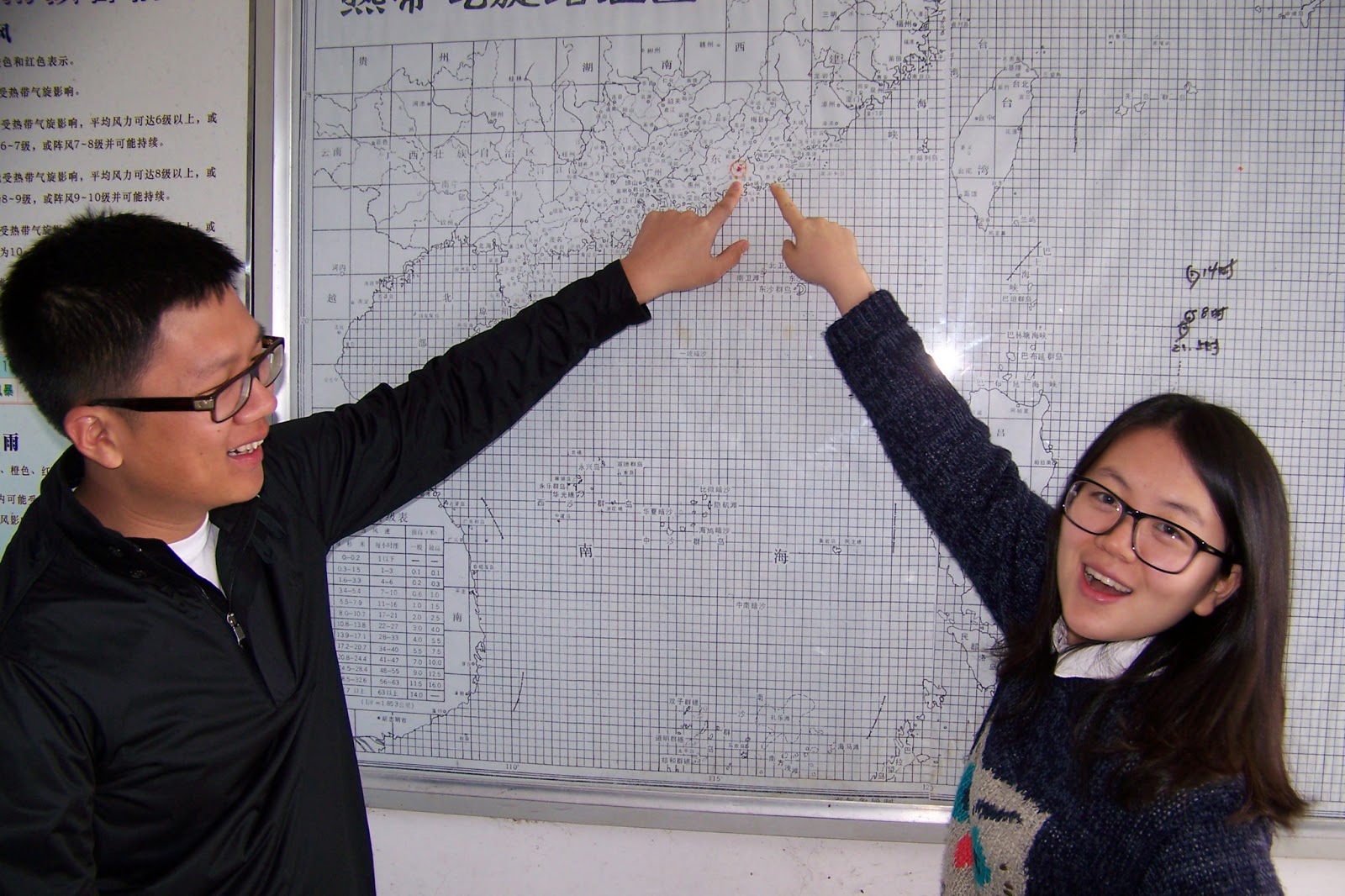
With a proper understanding of Chinese and a very detailed map, it is even possible to locate his home village. (To give you an rough idea of where to put your finger on a map of China, Taiwan is approximately behind Yujia's elbow and Hong Kong is approximately behind Edward's.)

With these interests expressed, but no clear sense of where we were going or when or how, beyond the JFK to Hong Kong and the Hong Kong to JFK parts, we departed for China. You might say this was "learn as you go."

Eighteen hours later, most of it in the air and the remainder in line at immigration in Hong Kong, we found Edward waiting for us.


You've got to love a city with buses that carry "sincerity" and "eternity" signs on the back.  From Hong Kong we crossed the bridge and stopped for another border crossing to enter the mainland.


The border crossing is more involved than this toll station, but not a lot more involved. It is rather like crossing into Canada from Buffalo, New York.


We rested from our long flights at the Edward's home, then from Shenzhen we traveled north and east about three hours drive to see the Yuanshan Temple in Lufeng.


Then on to Luhe, the town near the villages we would be visiting. Edward's family owns an apartment building there. Like their big home in Shenzhen, this building has room for much of the extended family. In fact, his father's older brother and family occupies the second floor.


From Edward's family residence in this town we took daily trips out to see the mountains and the villages that his parents were born and raised in.  First his mother's village . . .


 Then his father's . . .


I will have more to say about both of these villages in later blogs; but for this thumbnail sketch they must just be points on the map.

After three days of town and village life we drove back to Shenzhen.  From there we went to Guangzhou, as we did during out 2011 visit, where we ate with a lot of people we know, toured several old treasures, and sat in traffic.


At this point we were nearing the end. We went back to Shenzhen to pack and then to Hong Kong for a day before heading back for New York.


Day to day we knew generally where we might be heading, but often we waited for Edward to say, "We're leaving now," which was sometimes preceded by animated conversation in Chinese and sometimes came out of the blue.  Gradually as we became seasoned travelers, we knew the drill: grab your coat, put on your shoes, and wait at the door.

There it is in a nutshell, a succession of surprises and priceless experiences. In retrospect, the trip that rolled out before us one surprising moment at a time looks straightforward and easy.

And far too short!

Saturday, January 12, 2013

China Revisited -- 2013


Beginning at the End

Travel is about many things. Even when we think we know what lies there, beyond that door, travel is a new way of knowing.

At the end of our trip to China in this new year 2013 – Tuesday in Shenzhen, Wednesday in Hong Kong, Thursday New York – I am newly impressed with two fairly obvious things about travel.


The first of these is difference.

China has been, for us, a revelation in this respect. 

The un-surprising differences include language.  My one-phrase-Mandarin-vocabulary, thank you (Xiexie), has increased to six or seven – incremental, not dramatic. I have learned not one but two forms of greeting – and the Cantonese expression for excusing myself from the table.

It’s not much, I admit, but you don’t need much when you have a translator, even if, like Edward, he quickly runs out of energy for the linguistic work. I have discovered, however, that I can establish a kind of rapport by trying out my words. Everywhere we went, I got laughs with my phrases, which if nothing else relieved some of the stress over expectations.


Even without understanding the language, it is interesting to watch people talk in a language you don’t know.  It permits you to watch for and listen to the “other” aspects of conversation we can easily overlook.  Tone, volume, enunciation or lack of same, the little grunting noises we make in conversation that signal our attentiveness, body language, eye contact, gestures -- in short, anything that embodies meaning beyond the words spoken.

“Aren’t  you  bored?” I have been asked many times via Edward, who is our host, driver, travel consultant, and general handyman besides being our translator.

“No,” I usually say, “I am listening and learning a lot.”

The food, of course, is different.  I will have more to say about food in another post. Suffice it to say, Chinese food as we know it from American Chinese restaurants, by and large, bears little resemblance to Chinese food in China. I suppose you could say that what we get in America is a translation of Chinese food.

Food and language are the two big embodiments of culture that are exceptionally different. To say this is to say the commonplace, of course; yet it cannot be overstated. Food and language are who we are: our present and future as well as our past.


There are many other differences, too – faces, for example. By this I do not mean the obvious notion that Asian faces look different from my own Germanic face.  I mean that Chinese faces are so different from one another. You will immediately understand that I am suggesting the recognition of individuals rather than of race.  It is amazing, nonetheless, to see such an obvious fact unfold in front of my eyes.

The second aspect of travel that impresses me now is recognition.

I suppose this happens both inwardly and outwardly.  A broom is a broom even if it is unlike any broom I have ever seen in America.

Babies and small children, whom I love to photograph, are the same everywhere -- as are parents and grandparents who attend, carry, fuss over or herd them.


In the village we visited, a little girl came out with her grandmother to see the foreigners.  She was shy, but after some (what I understood as ) coaxing from her grandmother she tried out her English on us -- "Hello" -- and then let me take her picture.


It isn't much, I suppose, but for us it was a way to open the door, to catch a glimpse inside this place we had come so far to see.


Friday, October 14, 2011

Busan Journal,China Adventure, Part IV: Edward's House

The Family House

When I picture a house in China, the image I usually summon is a quaint old single-story row house with a curving roof line on a crowded, crooked alley.Or maybe in a modern city, an apartment in a high rise with narrow hallways and small rooms. Like most people of our time who have not traveled, my brain pulls together a lot of notions from movies I have seen. Impressions of America are compiled in the same fragmented and haphazard way I should think.

Edward's family apartment, where we went to meet his grandmother on the evening of our second night in Shenzhen comes close to what I had imagined, although the rooms were bigger and more numerous.  It was good to see a real family dwelling to replace what I had inaccurately imagined
.


Just before noon of that day, after our visit to the cultural center of Shenzhen and meeting up with "our kids," we got into cars for a ride to the development where Edward's parents are building a new house. I use the word "development" here, but here too what we found is not what I usually think of in American terms as a development.  It is in fact a huge gated community, with the amenities of a city on the premises.

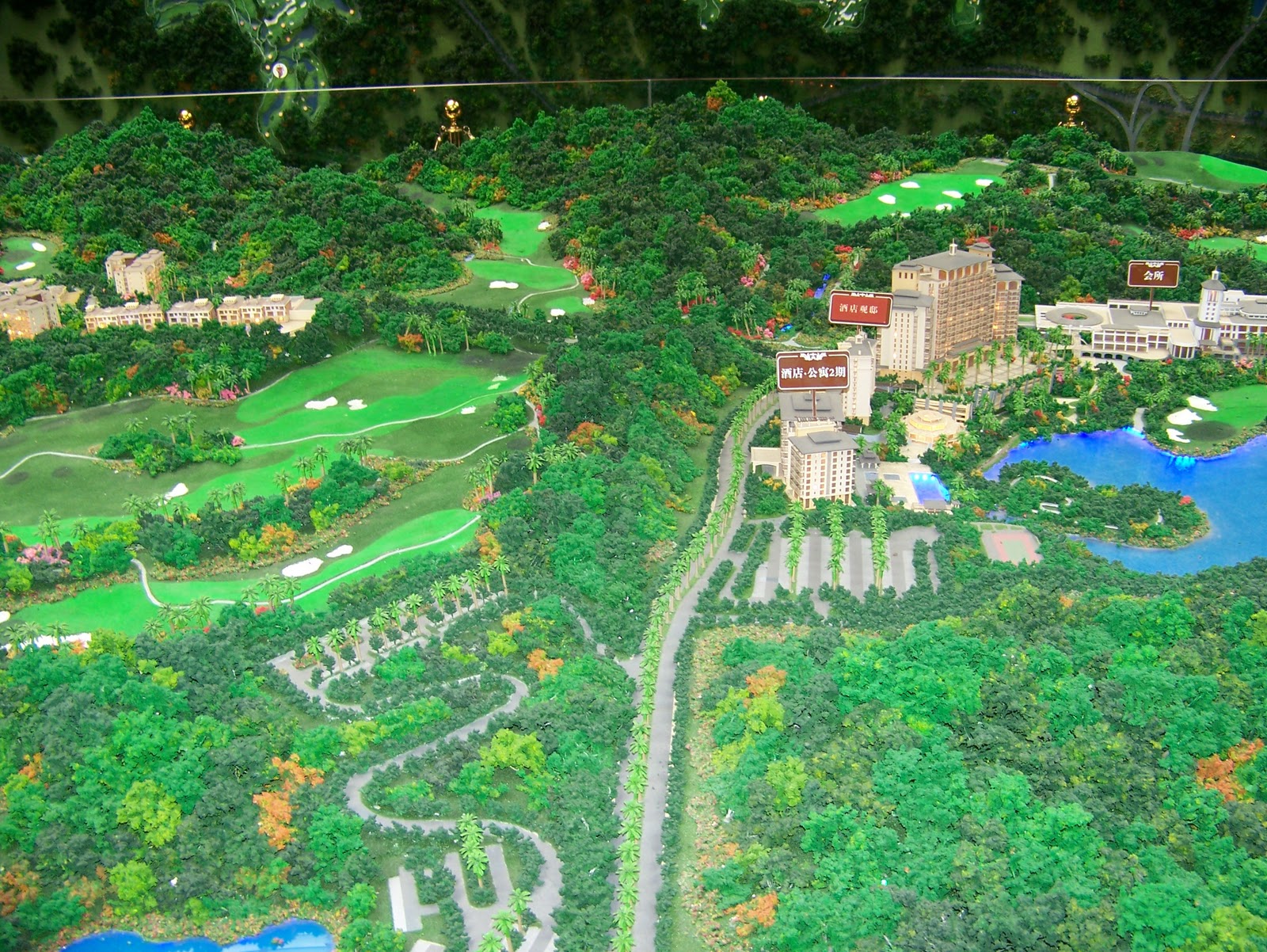
These amenities would include six golf courses and the "country club" complex where we had "lunch"  before we actually visited the house itself. I took pictures of everything in sight, of course, including the huge scale model of the community.


Lunch was a buffet that defies description.  I was so impressed that a noodle chef, one among many chefs, was actually making "fresh" noodles as we browsed the food options that I stopped to make a video of his performance.  My interest was greeted with laughter from the other chefs, who applauded when I finished. I think maybe the video may have brought him some teasing, too.


There was enough physical drama involved in turning a lump of noodle dough into the long thin uniform noodles we are used to eating to keep an army of kids entertained.


While I am aware that noodles do not originate in cellophane packages on grocery store shelves, I have never seen them made before.  I suppose it is a little like the proverbial city kid who has never gotten closer to a cow than the milk carton in a store. What a treat.

After eating we headed for the new Zhang house, which has a gate of its own off a cobblestone residential street. As one impressive sign of China's growing affluence, there are quite a few of these houses being built and occupied in this newly developed area.


The house has four floors with each floor being designated by its function or by the family members occupying the floor.  Edward and his brother, for example, have a floor, with their own bedrooms, sitting room, and game room.  His parents have another floor.  As the house was not yet occupied and at that point only partially furnished, many of the rooms have a similar look in my photographs. But we spent quite a bit of time touring room to room, floor to floor.


The central living room is dominated by a twenty foot ceiling and a huge chandelier. Midway to the ceiling along the back wall is the balcony overlook of the floor Edward and his brother will occupy.


Due to its stage in the process of being furnished, as I have said, much of what we saw had to be filled in with explanation as to what would be added before the family moved in, as with this bedroom.


The marble walls, hardwood floors, ornamented wood furniture styles are all apparent, although the stuff of family life had not arrived.


We were, of course, all impressed and envious of the video room with its high tech cushioned seats,


and the Olympic sized pool table,


and the sitting room between the two where Edward's mother served us tea and snacks.


It is hard to construct an adequate picture of the house even using pictures.  There was a huge kitchen, two dining rooms (dedicated to Chinese style eating or western style eating), laundry room, maids' rooms, sitting areas, an elevator, flat screen TVs on the wall in nearly every room in the house, bathrooms everywhere, a huge garage, and places we didn't even get to.

It seemed a little too much for one family of four, which is the way an American mind works.  But a better way to think about it is that it is a family home for the extended family.  This means that when uncles and aunts and cousins, brothers and sisters and spouses, grandparents, family friends and invited guests come, as is likely, on holidays or festival days, there is room for everyone to eat, play, talk, sleep, and hang out.  I'm not sure how the modern term "hang out" fits the traditional Chinese occasions to gather as a family, but it is a similar idea.


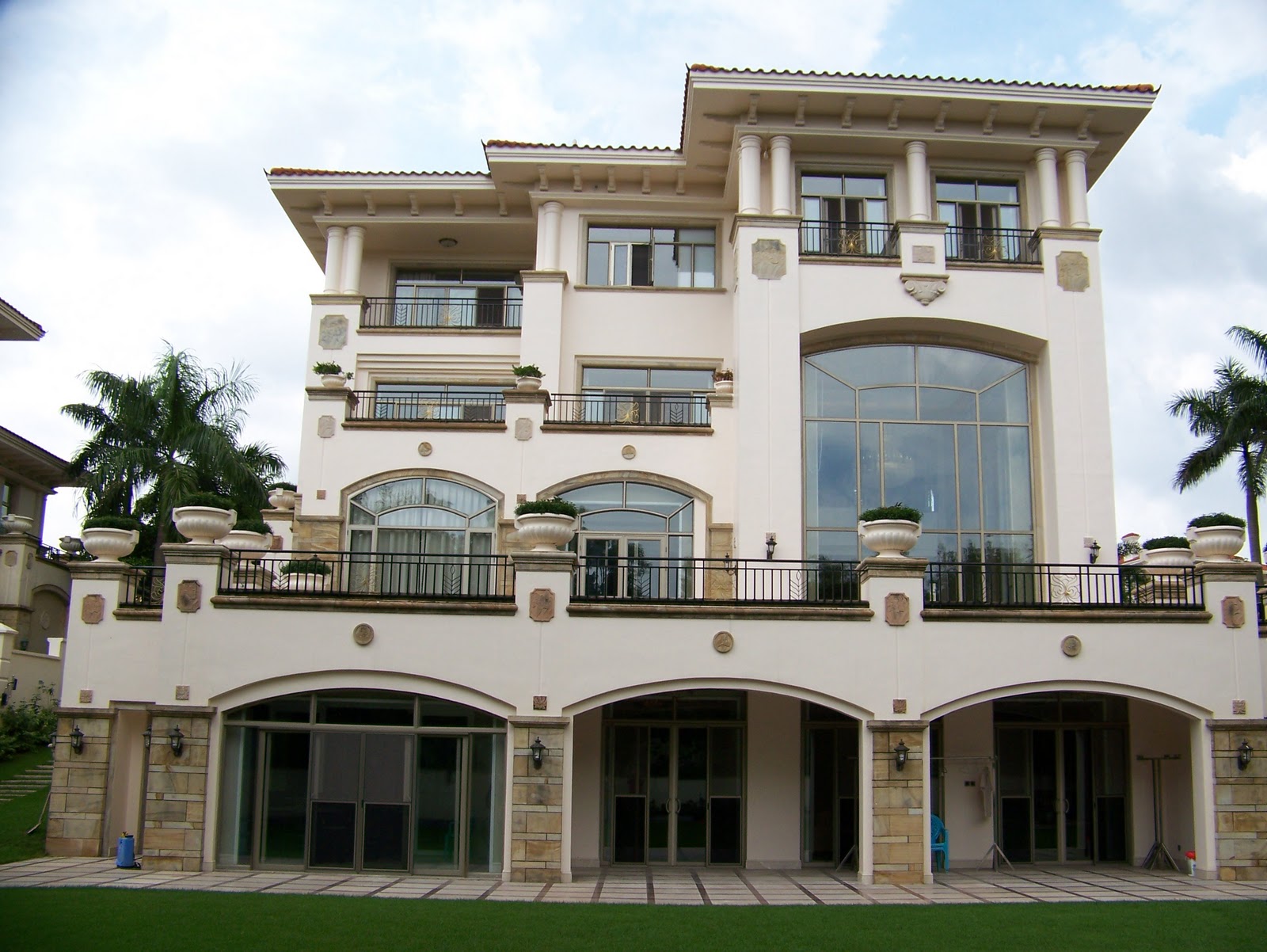
Outside, the house offers many different looks.  The architecture is interesting, and I got better photographs from the yard or looking toward the neighborhood than I did inside.  Sadly, my skills are not always up to the task at hand.


This view from the back yard almost shows the chandelier through the tall windows middle right. The central ground floor glass doors leads straight to the pool table. But the highlight of the back yard is the fish pond to the left of where this picture is taken,


an outdoor sitting area in the other direction,


and a golf course beyond the wall, giving the view from the house a feel of being out in the wild and well-tended countryside.


Then it was back to the Shenzhen center for another big royal feast and introductions to Edward's grandmother.


Probably the most astonishing thing about the house for us was when Edward told us that his father was under the impression that this was how most Americans lived.  An interesting observation, not all that different in its way from how I had imagined the Chinese live.