Showing posts with label Hong Kong. Show all posts

Thursday, August 22, 2013

China Revisited 2013 [34]

Hong Kong from The Peak

After our climb to The Big Buddha, the tofu pudding, the glass gondola return trip,  we rode the Hong Kong subway into the heart of the city for a visit to The Peak. The Peak is the highest vantage point in Hong Kong for viewing the central city.

Getting to The Peak, like getting to The Big Buddha, requires riding a rare form of transportation. In this case it was a 10 minute ride on a 125 year old tram railway that ascends 1300 feet in 10 minutes. Officially, the gradient is between 4 and 27 degrees, but from a passenger's perspective it seemed closer to 45 degrees, with most of the trip on the steepest part of that spectrum.

I was unable to manage a clear picture of the tram. For anyone who has made the voyage, the tram resembles the cog railway that climbs Mt. Washington in New Hampshire, which is only to say that the tram is an old style railroad car (two actually) with all the seats facing one direction -- uphill.

When the tram left the station and began to climb, we thought, momentarily, that we would be in big trouble if the mechanism that grips the cable failed.  Five or six minutes into the climb, we began to wish the old trains had head rests.  The ride was a serious and literal pain in the neck.

Nonetheless, the ride was clearly an improvement over the means of transportation employed prior to the building of the tram in 1888. In those days, anyone wishing to ride to the top was carried in a frail bamboo sedan chair, powered by what the brochure calls "two strong coolies."  As with their brothers who power rickshaws, apart from the benefit of the exercise for "staying in shape" it is hard to imagine an upside to a job like this. I found no information about the time required for a sedan chair hike to the vista.

At the top of the tram run, we disembarked at the base of The Peak Tower; at the top of this tower is the best view of Hong Kong anywhere.  Six or seven escalators and one more ticket booth later, we arrived on Sky Terrace 428.


We arrived a little early for the light show that begins at dusk.  The light show is not entertainment as, say, a laser show might be.  It is simply the point at which the tall new buildings around the harbor in the center of Hong Kong turn on their external lights.  This kind of light show is a fairly common feature of the modern Chinese cities we have visited so far. The lights in downtown Guangzhou, for example, are quite impressive.


As with the tram itself, I had trouble getting a clear picture of the lights themselves as they came to life on cue, which was 6:30 if I remember correctly.  My difficulty this time was not motion but the fog, the crowds (which became denser as 6:30 approached) and, of course, my on-going camera issues.

Street level Hong Kong was reasonably warm on this day in January, but the air at The Peak, given the departing sunlight and the steady breeze was rather cool.

After dinner in the tower we took the tram back down the steep hill.  To my surprise, we rode backward down the hill. Too bad, I thought it would have made for better viewing to see where we were going rather than where we had been.  Then it occurred to me that forward facing seats would have dumped us onto the floor as soon as we hit the slope.

We had a set up an elaborate system to be sure we awoke on time to catch the shuttle over to the airport for our flight back to the States. 

But the arrangements were unnecessary. At 5 a.m. the fire alarm jolted us out of bed.  We went to the door and looked out at the empty hallway. No smoke, no burning smell. 

Pretty soon Yujia appeared at our door to say, "Don't worry. Just stay in the room."

We did.  The alarm stopped.  We debated going back to bed and decided against it. The fire trucks that had gathered on the driveway below our window turned off their lights and rumbled away.

After welcoming us aboard for our trip home, the captain said we would have strong tail winds so we could expect a shorter trip to New York.  But when he turned off the seat belt sign, the largest Asian woman I have ever seen flopped her seat back into my lap, and I knew it was going to feel like a long trip regardless of how much time the tail winds saved us.


Thursday, August 8, 2013

China Revisited 2013 [33]

The Big Buddha

Our last day in China was both a day of preparation for our flight back to New York and a day for sight-seeing in Hong Kong.  We said our good-byes to Edward's grandmother and the two maids, who had been so kind and hospitable to these high-maintenance guests, loaded our bags into the van, and headed for the border.

It doesn't take long. There are two border check points, one for China itself and one for Hong Kong. Paperwork needs to be in order, passports ready.  After the second border crossing the van shifted from driving on the right to driving on the left, British style, and we crossed the river onto the islands that comprise Hong Kong.

It was a hazy January day, but even with restricted vision, it is clear that the harbor is extremely busy with all manner of boat traffic.

Our first stop was the airport hotel where we would spend the night in preparation for our early morning flight. Near the airport is a mall with a train station, Tung Chung, where we went next to meet Yujia, who was to arrive from Guangzhou to be with us on our last day. It is always a treat to have Yujia on board.

The mall also houses the cable car terminal for the aerial tours out over the Tung Chung Bay, up and over the hills that form the Lantau North Country Park to Ngong Ping Village, which lies at the base of "The Big Buddha." We tend to think of Hong Kong simply as a congested city, which is true enough, but it also includes forested hills on multiple islands.

Edward booked a "crystal cabin" for us, which meant the cable car had a clear glass bottom. It was both a generous gesture, as these crystal cabins are more expensive, and a bit of teasing since both Donna and I fear heights. Edward took advantage of this knowledge to remind us at every opportunity just how high up we were.

The glass bottom did not concern Edward or Yujia, nor, apparently, Edward's mother. They moved about quite happily, while we held onto the plastic seats.

I offset the effect of riding without visible support just a bit by setting my backpack between my feet to hide the view straight down. It also helped us to look straight out rather than down through the glass floor. For me, at least, once the car was out and away from the platform, I was OK.

 The cable ride is 25 minutes.  About 18 minutes into the ride, after we have crossed the bay and the first set of hills, the Buddah comes into view in the distance.  Because it was hazy, as I said earlier, the statue at first was mostly a dark, ghostly presence in the distance.


As one would expect of a Buddha, it just sits placidly atop the hill at some distance from the cable route.  We disembarked at Ngong Ping Village, which is a new commercial enterprise constructed as a tourist destination. I was surprised to learn that the Big Buddha itself is of recent construction; it was finished in 1996. There is a mix of commercial and religious forces at work here that I cannot entirely disentangle; but my best explanation is that after years of suppressing religious practices, the Chinese authorities have begun to encourage the ancient forms due to their commercial value. They are, in fact, beneficial to the local economy.  I realize as I make this observation that Hong Kong was under British control during the construction of the Buddha and the village. That fact does not dissuade me; I think my explanation is likely close to the truth.

There is a Buddhist monastery in the village to serve the needs of worshipers who come to the temples that are also part of the complex.


We had lunch in the village, but not at Zen Noodles, which had been my suggestion. As near as I can tell we ate at Ngong Ping Garden Restaurant.  I have eliminated most of the other possibilities -- Starbucks, Subway, Zen Tiawanese Bistro, da dolce Gelato Italiano -- you get the idea.

The village itself is basically one street of stores that head through a set of gates toward the Po Lin Monastery and the hill dominated by the Big Buddha. The Monastery is separated a distance from the shopping district by a stone-paved pathway lined with figures of historic generals whose deeds in battle have legendary status. The shrines in front of the monastery were filled with people burning incense.  Smoke and ashes were everywhere.


The Monastery itself is beautifully kept. Clearly the commercial prosperity of the new village has allowed the Monastery itself to prosper and, in turn, to serve as an colorful display of ancient art and architecture. The detail in these traditional styles is quite astonishing.  I am personally attracted to the little animals that one finds along the roof ridges, which were reminiscent for me of similar traditional styles in Korea.


After we had looked at the Monastery, we climbed the stairway to get a closer look at the Big Buddha -- 15 separate sets of 14 steps, or, 210 steps altogether. There are a few more steps at the top if one wants to pay a separate admission to get up close and personal with the Buddha itself, but we all thought 210 steps was plenty.


My impression was that few people, maybe just the seriously devout, actually paid the separate admission. Most settled for the 210 steps.  There was actually quite a bit to see from that vantage point. In the little rooms beneath Buddha's platform was a set of large room that had information about Buddhism, photographs and diagrams about the construction of the Big Buddha itself, and items for sale to help you remember your trip.

 At the bottom of the 210 steps again we stopped for a snack of tofu pudding in an eating hut that also reminded me of Korea -- plastic hung walls, outdoor cooking.  The tofu pudding was good although I don't have any memory of the exact taste.

Then, having seen the Big Buddha, we checked to see where in the world we were -- a mere 13,000 km from New York -- before we boarded our crystal cabin for the ride back to Tung Chung, Hong Kong.


Wednesday, April 10, 2013

China Revisited -- 2013 [#20]

Hakka Village

After the celebration for Edward's father, we returned to the family house in Lehu. Edward's cousin was there to meet us. We had tea and tried to converse. He teaches geography in a junior high school in town. And when Edward's parents are in Shenzhen, he takes care of the top three floors of the building. After several exchanges -- basic questions, short answers -- we focused on our tea.

Late in the afternoon we climbed into Edward's car and followed his cousin, who was weaving in and out of traffic on a scooter. More than once I imagined chase scenes through tight, crowded, decidedly foreign streets as in the Bourne films. He would dash through small spaces between cars and then have to wait for us to make a bigger opening.

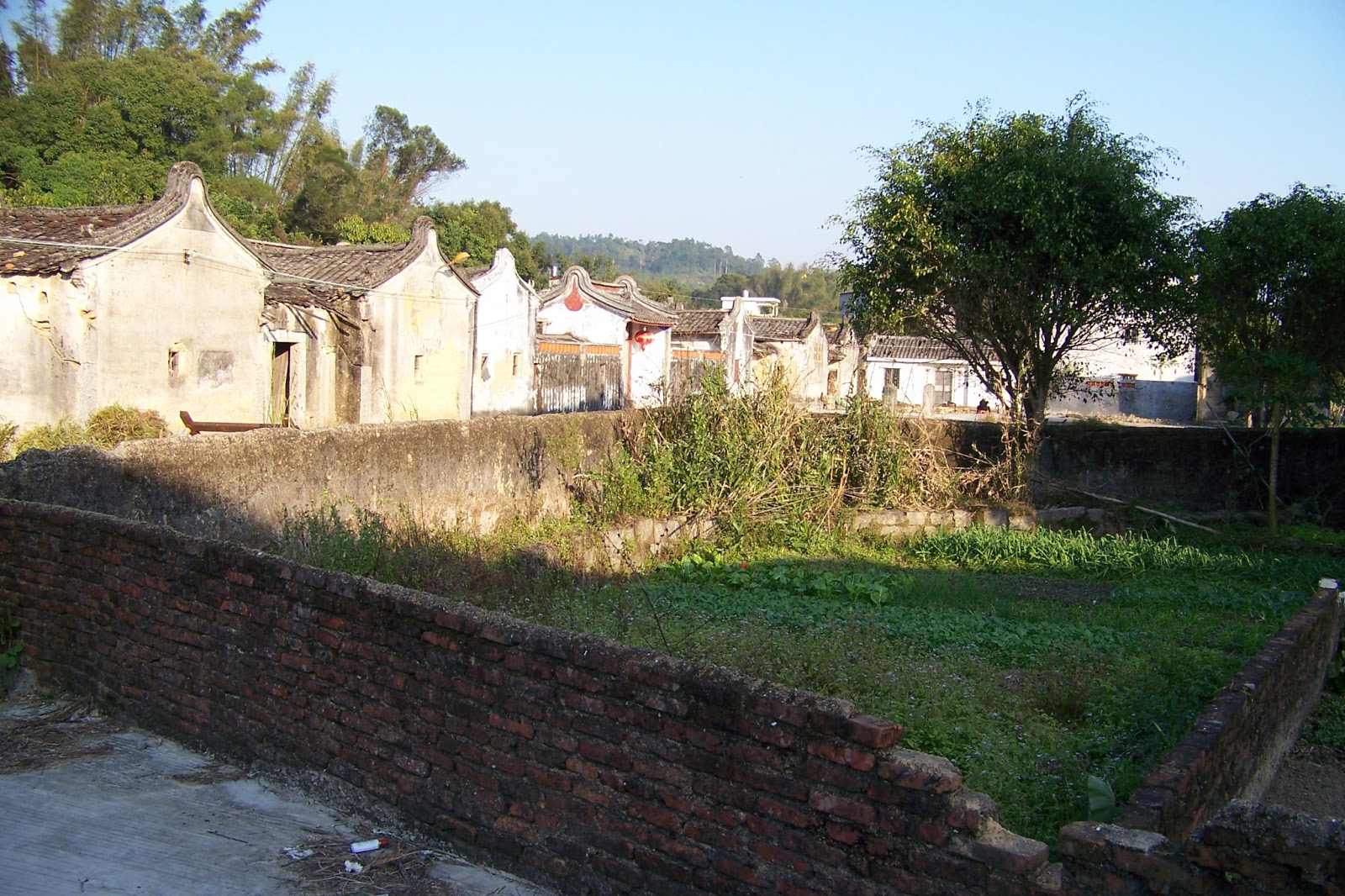
He led us to an "old" abandoned Hakka village somewhere at the edge of town, so we were only dodging traffic for maybe 20 minutes. Still, it seemed a world away.  The village compound is near a development of new, essentially middle class homes -- two story boxy structures made of concrete and brick, softened with tile where Americans would use shingles. The new development is still being built; but it is difficult to know how old the Hakka village might be.

My initial impression, based on what we learning in this preserved village, was that the Hakka are a distinct people group within China, one of about 56 people groups that are recognized and "protected" by law. That impression is not correct. They are a branch of the majority Han peoples but have a distinct language and history. Edward describes the Hakka more as a culture than a race.

Not here, but later in our visit, we detected a measure of irritation (resentment?) toward "privileges" that accompany this protected status. It did not seem to be directed at any one in particular, but I felt it was not all that different from feelings one hears in America toward perceived "special treatment." The impression that such protections are unfair or undeserved must be universal.

Whatever an accurate read of these feelings might be, the government clearly has decided that some of  old China -- what we might call China's diversity -- needs to be preserved.  This preservationist model is not consistently applied, however, as we know from the destruction of traditional neighborhoods in Beijing to make way for construction of Olympic venues in preparation for the '08 Games.

While this Hakka village on the outskirts of Lehu is deserted, it remains intact because of this protected status.  We saw no evidence of current habitation and some structures within the walled compound are falling down (below), yet whatever may have already been bulldozed for the nearby development, the village does not now appear to be losing ground. And there are signs that parts of the compound are still used.

The walled compound would have been home to 400-500 people.  People didn't live exactly "on top" of one another, as might be true in modern cities like Hong Kong with its crowded hi-rise apartment buildings, but they did live at close quarters.  Basically, they would have slept indoors and conducted their day-time activities -- cooking, talking, trading, discussing business, and so forth -- in the open areas. This pattern is identical to what we found in the two family villages we had visited earlier in the day.

There are (or were) nine courtyards in this Hakka village, and 18 halls, which were used for worship or meetings.  The structures that served as homes lined the walls of the courtyards.  A literal translation of the Hakka word for these courtyards is "sky well."

Quite apart from the practical logic of this term, which becomes clear when you see the structures, it is such evocative language.

One enters each courtyard by way of tall doors decorated with fierce warriors. We saw these warriors everywhere. They serve to keep out misfortune, bad luck, harm. For this gate, one fierce warrior and one gentle warrior,Yujia, in a Minnie Mouse t-shirt, guard the gateway to the sky well. Inside, beyond the high threshold and across from the gate is one of two halls, this one now barred by a locked iron fence. To the side of the hall entry were "greens" left to dry in the sun.

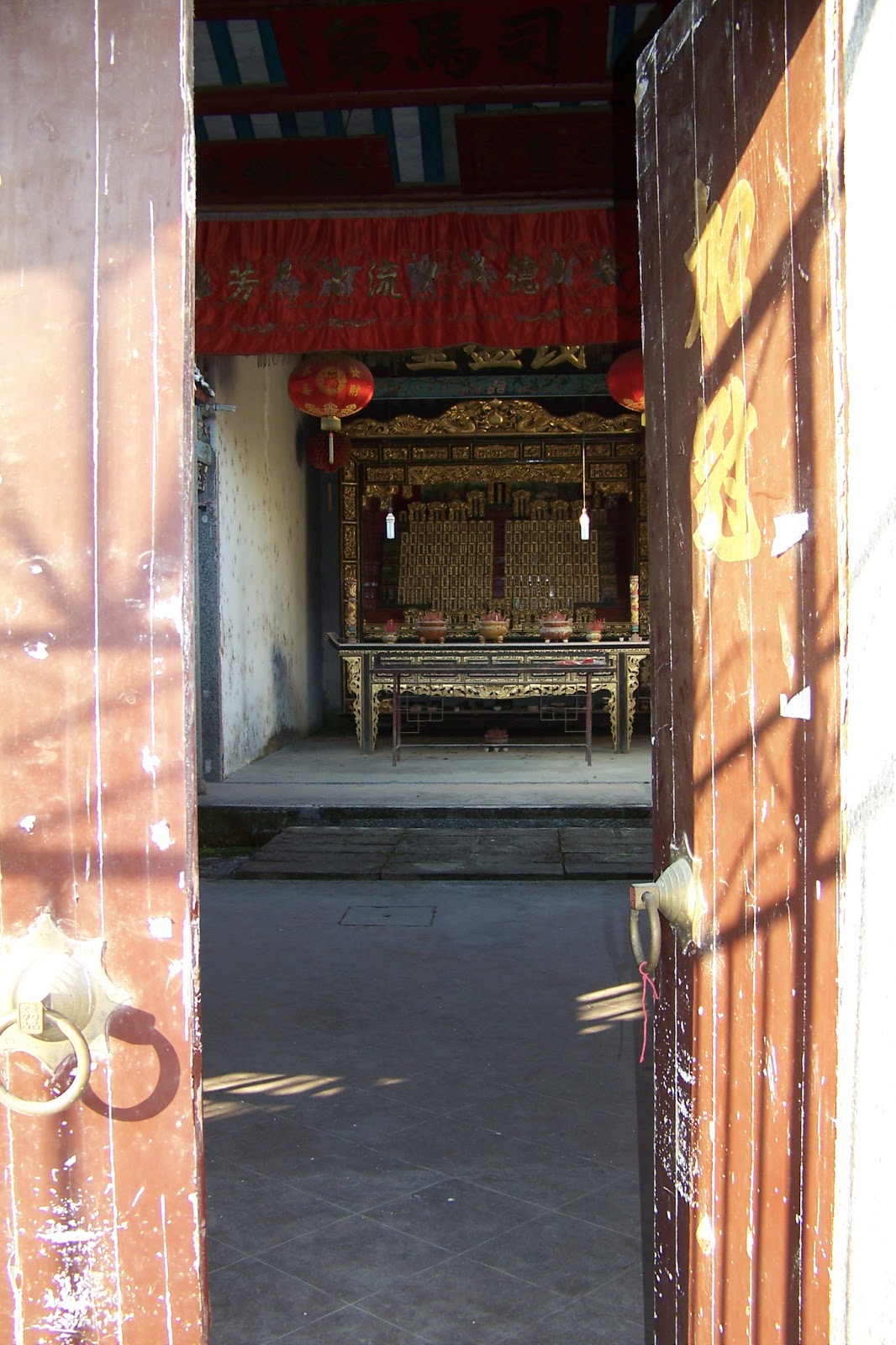
The hall behind the locked iron gate is an ancestor hall, with its altar, symbolic paintings, incense sticks, signs signifying various prayerful sentiments, and food brought to show respect for the ancestors.  The orange objects on the table in front of the incense stick urns are, in fact, fresh oranges.

All these things -- the dried greens, the oranges and the recent red door frame panels, the cloth hangings and lanterns that are still vividly red -- are evidence of continuing activity in the village.


I poked my camera through the bars and took a long shot of the ancestor hall. Edward's cousin tested the gate for us just to see whether we might gain entrance, but the lock held.

To the right of the door beside the window is a marble plaque noting the special characteristics of the architecture.
I must confess that I had never heard the name Hakka before we arrived, and I had to ask Edward to repeat the name several times before I got it straight. His family is Hakka by ancestry.


Often, of course, I found myself lost in reverie and separated from the group. I strayed to take pictures of things that interested me and things I just wanted to remember.


The gate house we had come through to get into this compound is itself an interesting structure with many interesting features.  When I was with the group, I asked a lot of questions, some of which couldn't be answered or easily translated. 


Outside the courtyard but inside the walls of the compound is a large pond, now stagnant.  I had noted ponds like this in other villages, both those we stopped at and those we drove past.

I surmised that these ponds were for raising fish, which are a staple in this region. It seemed a logical deduction, so I asked even though the ponds themselves do not look like they would sustain fish.

Edward consulted his cousin, who said the ponds traditionally served to put out fires. In the days when construction featured wood, a pond on premise meant that fires could be contained before the entire community went up in flames.


These curiosities are compelling to me, both as part of local history and as achievements in themselves. So many facets of Chinese architecture and ornamentation lend themselves to appreciation; their grace and symmetry alone are astonishing.


Roof lines, like brick walls and wooden doors and handmade brooms, are a favorite subject of mine. Patterns, parallels, repetition -- all warrant a closer look, although too often I felt like I was missing something crucial, the thing that would allow me to "get it."


Both outside and inside the attention to detail that is traditionally labor-intensive and painstaking strikes me often as effortlessly elegant. In addition, none of this artistry is impractical; every detail serves a second, pragmatic function.


As often happened, the group had gathered to go while I was still deep in my investigations. The next time we come . . . I kept thinking, both of this Hakka village and of many places we visited. So much to see, so little time to see it.


Near the car we stood for a photo op with Yujia, Donna, and Edward's mom . . .and a photo farewell to the sole visible inhabitant of the village, who was not interested in us at all.

Then we were off, chasing the scooter through the streets again into the new development to see the cousin's new house.


Saturday, January 12, 2013

China Revisited -- 2013


Beginning at the End

Travel is about many things. Even when we think we know what lies there, beyond that door, travel is a new way of knowing.

At the end of our trip to China in this new year 2013 – Tuesday in Shenzhen, Wednesday in Hong Kong, Thursday New York – I am newly impressed with two fairly obvious things about travel.


The first of these is difference.

China has been, for us, a revelation in this respect. 

The un-surprising differences include language.  My one-phrase-Mandarin-vocabulary, thank you (Xiexie), has increased to six or seven – incremental, not dramatic. I have learned not one but two forms of greeting – and the Cantonese expression for excusing myself from the table.

It’s not much, I admit, but you don’t need much when you have a translator, even if, like Edward, he quickly runs out of energy for the linguistic work. I have discovered, however, that I can establish a kind of rapport by trying out my words. Everywhere we went, I got laughs with my phrases, which if nothing else relieved some of the stress over expectations.


Even without understanding the language, it is interesting to watch people talk in a language you don’t know.  It permits you to watch for and listen to the “other” aspects of conversation we can easily overlook.  Tone, volume, enunciation or lack of same, the little grunting noises we make in conversation that signal our attentiveness, body language, eye contact, gestures -- in short, anything that embodies meaning beyond the words spoken.

“Aren’t  you  bored?” I have been asked many times via Edward, who is our host, driver, travel consultant, and general handyman besides being our translator.

“No,” I usually say, “I am listening and learning a lot.”

The food, of course, is different.  I will have more to say about food in another post. Suffice it to say, Chinese food as we know it from American Chinese restaurants, by and large, bears little resemblance to Chinese food in China. I suppose you could say that what we get in America is a translation of Chinese food.

Food and language are the two big embodiments of culture that are exceptionally different. To say this is to say the commonplace, of course; yet it cannot be overstated. Food and language are who we are: our present and future as well as our past.


There are many other differences, too – faces, for example. By this I do not mean the obvious notion that Asian faces look different from my own Germanic face.  I mean that Chinese faces are so different from one another. You will immediately understand that I am suggesting the recognition of individuals rather than of race.  It is amazing, nonetheless, to see such an obvious fact unfold in front of my eyes.

The second aspect of travel that impresses me now is recognition.

I suppose this happens both inwardly and outwardly.  A broom is a broom even if it is unlike any broom I have ever seen in America.

Babies and small children, whom I love to photograph, are the same everywhere -- as are parents and grandparents who attend, carry, fuss over or herd them.


In the village we visited, a little girl came out with her grandmother to see the foreigners.  She was shy, but after some (what I understood as ) coaxing from her grandmother she tried out her English on us -- "Hello" -- and then let me take her picture.


It isn't much, I suppose, but for us it was a way to open the door, to catch a glimpse inside this place we had come so far to see.


Wednesday, September 28, 2011

Busan Journal, China Adventure, Part III: Shenzhen

The New China: Buildings, Food, and our Kids

Between Hong Kong and Shenzhen lies a border that is like national borders everywhere. Access to Hong Kong or access to "the mainland" from Hong Kong is managed efficiently this way.  Hong Kong can remain the international city it has always been, and China can maintain control over who gets to enter or leave its own space.  It appears to be mutually advantageous. Fears in the west about what would happen to Hong Kong once the British turned over management to China a little more than a decade ago largely failed to play out.


With visas in hand, we left Hong Kong with Edward in a van driven by a family friend as dusk settled into darkness. We saw very little except for lights.  The highway we traveled had all the charm of an American interstate.  Nevertheless, once we had passed beyond the border station where our newly issued visas were examined, we felt suddenly overwhelmed.  It was a true can-you-believe-it experience.  We are actually in China! Imagine that!!!

I had had a similar feeling in 2004 when a group of us, middle-aged men and our teen-aged basketball-playing sons, had traveled to Russia to help the Wesleyan Church in Vladimir.  The teenagers were suitably impressed, I suppose, but for those of us who grew up during the black and white days of the Cold War, being in Russia was almost too much to take in.

China was even more unimaginable -- if that is possible.


Yet there we were.  China!

We were met in Shenzhen by Edward's parents, who put us up in the Elite Hotel, near their apartment building. We ate the first of a series of grand meals, with real Chinese food -- not the fake Chinese food we Americans are so fond of.


Apart from eating, our first morning in Shenzhen was spent visiting the cultural center near the city hall.  Shenzhen is a new city, a modern city.  Since it has been built from the ground up in the last three decades, all the buildings are recent and spectacular.


The Shenzhen City Hall is built with a flowing roof to suggest an eagle in flight. Across this wet plaza a young couple posed for photographers, in a scene that could have come from any city in America.


The cultural center itself houses many attractions, from stores to a library to performance halls.  A bronze statue of Pavarotti welcomes visitors to the complex.


We stopped in the midst of the plaza to have our picture taken with Edward's mother and father.


Edward's mother made sure we were well taken care of.  She led Donna by the hand everywhere we went. It was, I think, good insurance for my wife, a woman who tends to be navigationally at risk.


We visited a very large bookstore with scores of people sitting on the floor reading. Nearby was a library with a huge map of the city in the foyer.


Edward agreed to explain its geography. Well, he explained the geography without prompting; but what he actually agreed to do for me was to pose for a picture.


In a passage between buildings we found a street musician playing haunting traditional melodies on an electrified erhu.  Like the little girl, I am drawn to performances of this kind, but I am not bold enough to stand as close as she was. 

In the performance center itself I found many things to catch my attention, including a fascinating ceiling made of hundreds of glass panes and dozens of angles.


Apparently, I was unaware that my photography interests were pushing us off schedule.  When I finally did catch on, we zipped back to the hotel where we were surprised to find a number of former Houghton Academy students waiting to greet us.


Seeing Yujia, Simba, Yi, and Syan coming toward us on the sidewalk made us feel just like old times in Houghton.  If it had not been for the tropical air, we might have thought we were home.

We were not going to see the Great Wall or the ancient cities, but we were able to see what we had come for -- our kids!

Friday, September 9, 2011

Busan Journal, China Adventure, Hong Kong

Hong Kong and the Real China

It all happened so fast, both our trip to China and our twenty-two hours in Hong Kong, that it remains just a tad blurry in my mind.


Edward, whose name (when he is not posing as an American) is Zhang Zhijie, guided us through the necessary steps for an expedited visa, shepherded us to the hotel, and got up early the next morning to show us some sights in Hong Kong before the visas were ready and we would leave for Shenzhen.
Hong Kong is well-known for its hi-rise buildings.  We were expecting a few looks from way up. Still, the view from our hotel room was somewhere between overwhelming and dizzying.


Street level was no less awe-inspiring for country folks like us, even after four months in London and four more in Busan, a city of 3.7 million.


We were more than a bit surprised by the laundry hanging out above the streets. What happens if you fumble Dad's favorite shirt or fail to pin Mom's floral unmentionables as you try to attach them to the line?  What is the word for the sudden fear that rises into your throat as the lost garment flutters into traffic below?

Mist and rain made it difficult to get better pictures of this laundry phenomenon.


The British influence from its 99 year "lease" of Hong Kong were visible in many things, from the English place names on signs to the double decker buses and the Victoria Park, a huge tropical garden that we wandered through after the early deluge forced us to delay our visit to the Walk of Stars.


On a future visit to Hong Kong, preferably in a cooler, drier season, I would like to tour the gardens again to look more closely at the gigantic trees and bushes and flowers that do not grow in our more temperate climate.


Eventually the showers ended for the day and Edward took us from the Victoria Park to Hong Kong's famous Avenue of Stars, where we found someone willing to take a picture of the three of us.


Further down the Avenue of Stars we came across both a coffee shop, which are common in Korea but hard to find in China, and the Hong Kong Dragon Boat races.


The dragon boats resemble sculls, although they are paddled like canoes. A drummer in the bow sets the pace for the crew. Sad to say, as the humidity was exceptionally high from the morning downpours and as we have an exceptional intolerance of humidity, we opted for a half hour in the air conditioned coffee shop rather than a seat on the bleachers to watch the races.


We did spend a few minutes watching another race, a single boat we found at a small pond in Victoria Park being operated by remote control. The man with the boat simply flung it into the water and raced it back and forth from one stone edge to the other.  The boat flew along the water so fast and the man with the controls waited so long to turn the boat, I kept expecting it to crash before it turned.


I don't know whether the boys sitting on the wall behind him were his sons, but I found myself watching them as they watched the boat flash back and forth with its dramatic rooster tail.


Mid-afternoon we took a taxi to another part of the city, where the travel agency promised to return our visas and passports.  They were not ready yet.  They were on the way.  It would be an hour.  Or two.  A little bit longer.

But it was OK -- Edward did not seem concerned. We just needed an air-conditioned place to pass the time.


Eventually, we just got into the van that Edward's father had sent to take us to Shenzhen since it was waiting and the airconditioner was running.  Then with passports and visas in hand, Edward popped out of the crowd on the sidewalk, climbed into the van, and we took off, winding our way out of Hong Kong in the fading afternoon toward Shenzhen and the real China.