Showing posts with label China. Show all posts

Wednesday, January 23, 2013

China Revisited -- 2013 [#4]

WHERE ARE WE GOING?  WHERE HAVE WE BEEN?

In October when we were invited to spend the Christmas Break with Edward's family in China, we named a few places we would like to visit: Beijing, Xian, the Great Wall.  Tibet, via the week-long train ride from Beijing.

Beijing, come to find out, is a four hour plane ride from Shenzhen, where Edward lives.  It is very cold in winter, which would mean packing extra winter clothes, which seemed prohibitive. And the smog this winter has been intense and debilitating.


Xian, site of the life-size clay army, is far from Shenzhen, too, and also cold. Ditto the Great Wall.


Tibet on the train was a joke, although we'd have done it if Edward and his mother had agreed.

Since Edward was not going to plan the itinerary until he had gone home for the break (he attends Syracuse U), we also gave him some general ideas about the kinds of things we would prefer:  old over modern, country over city, the seldom-traveled over the much-trampled tourist meccas, people over most alternatives, traditional Chinese anything over global or western or "fusion" stuff.

Especially, we made a specific request to visit the "home village" Edward has mentioned many times.
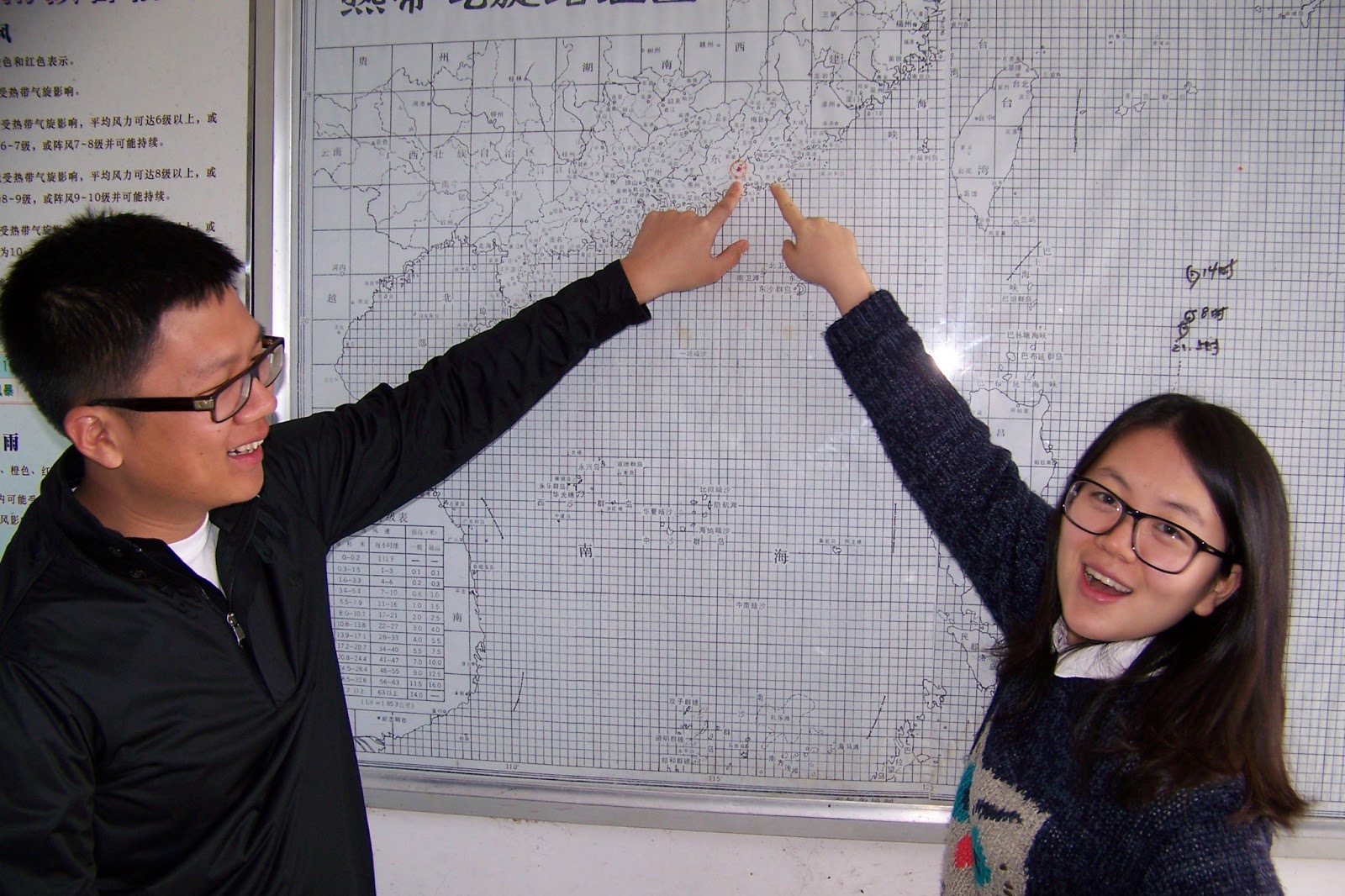


With a proper understanding of Chinese and a very detailed map, it is even possible to locate his home village. (To give you an rough idea of where to put your finger on a map of China, Taiwan is approximately behind Yujia's elbow and Hong Kong is approximately behind Edward's.)

With these interests expressed, but no clear sense of where we were going or when or how, beyond the JFK to Hong Kong and the Hong Kong to JFK parts, we departed for China. You might say this was "learn as you go."

Eighteen hours later, most of it in the air and the remainder in line at immigration in Hong Kong, we found Edward waiting for us.


You've got to love a city with buses that carry "sincerity" and "eternity" signs on the back.  From Hong Kong we crossed the bridge and stopped for another border crossing to enter the mainland.


The border crossing is more involved than this toll station, but not a lot more involved. It is rather like crossing into Canada from Buffalo, New York.


We rested from our long flights at the Edward's home, then from Shenzhen we traveled north and east about three hours drive to see the Yuanshan Temple in Lufeng.


Then on to Luhe, the town near the villages we would be visiting. Edward's family owns an apartment building there. Like their big home in Shenzhen, this building has room for much of the extended family. In fact, his father's older brother and family occupies the second floor.


From Edward's family residence in this town we took daily trips out to see the mountains and the villages that his parents were born and raised in.  First his mother's village . . .


 Then his father's . . .


I will have more to say about both of these villages in later blogs; but for this thumbnail sketch they must just be points on the map.

After three days of town and village life we drove back to Shenzhen.  From there we went to Guangzhou, as we did during out 2011 visit, where we ate with a lot of people we know, toured several old treasures, and sat in traffic.


At this point we were nearing the end. We went back to Shenzhen to pack and then to Hong Kong for a day before heading back for New York.


Day to day we knew generally where we might be heading, but often we waited for Edward to say, "We're leaving now," which was sometimes preceded by animated conversation in Chinese and sometimes came out of the blue.  Gradually as we became seasoned travelers, we knew the drill: grab your coat, put on your shoes, and wait at the door.

There it is in a nutshell, a succession of surprises and priceless experiences. In retrospect, the trip that rolled out before us one surprising moment at a time looks straightforward and easy.

And far too short!

Sunday, January 20, 2013

China Revisited -- 2013 [#3]

TEA?  ANYONE?

Our experience so far in our Asian travels, limited though it may be to Korea and China, is that Asians are very hospitable people. National expressions of hospitality differ, of course; but we have been welcomed and embraced everywhere.

Hospitality in China begins with tea. Always.


 Come in. Sit. Sit here in the best seat.  We are honored that you have come.


When you are seated on the couch or in the good chairs in front of the tea table, the host will pull up a short chair or a stool that puts him at the height of the table, lower than his guests, for ease of handling the water, pots, cups, and loose tea.

The host will begin to make the tea. In every home we visited -- and we visited quite a few -- and in most restaurants, we were offered tea.

Tea begins with a washing of the tiny tea cups.  Boiling water, which come from a small metal tea kettle on a quick-heat burner that is often part of the apparatus is poured into each cup, as you watch; or it is poured into the first cup and from there into the second, so that each cup in turn is washed in the hot water. The hot water is dumped onto the tea table itself, which is built as a slatted wood grating. The larger part of the tea apparatus, usually a rectangular wood device about four inches tall, consists of this grating with a platform for setting tea cups at one end and another for housing the hot-pot capabilities at the other end. We saw quite a few different tea tables, but they were all built with the same basic design.


The tea process is not women's work, as we observed it.  It was performed, usually, by the father of the house. In his absence, it was performed by the mother. In her absence, another adult relative took the honors. And so forth. Sometime the eldest available child steps up to the task.

In a restaurant, depending on the status of the establishment, it was performed by a manager or by a waitress.

The tea itself is made on the spot in a little pot.


 The tea is always loose. Boiling water from the hot-water kettle is poured over a small strainer containing the loose tea into the little pot and then, without letting it steep, directly into the tiny cups.  Traditionally, the first little pot of tea is also poured over the cups before the cups are filled and passed out.

The guests are offered tea first, then the others in an order that respects rank or seniority.  The tea cup is usually so hot from the boiling water that it must be grasped at the rim with the thumb and first or second finger. It appears to our western eyes as a strange way to hold the cups, but it is necessary.

Then, once you have sipped the tea or drained it, the cup is immediately refilled.

The hosts may also offer fruit, often sliced oranges or whole clementines. This is a particularly nice feature of Chinese hospitality since, for us at any rate, the timing of the next meal is indefinite.

On the other hand, I was frequently offered cigarettes by other men.  It was an informal, friendly gesture -- two cigarettes in an extended hand. One hates to offend, so in addition to jet lag I have come home with a terrible nicotine habit.


Just kidding.

Turning down cigarettes was not a problem, but turning down tea was not possible. By the end of a morning or an afternoon of visiting, we were on constant alert for restrooms.  We learned to take advantage of restrooms when they appeared rather than to wait until we needed them.

Another lesson we learned was simply to recognize how to handle the tea refills.  Since the host wants you to feel welcome, it helped to finish the first cup straight away.  That addresses the hospitality issue.  Then allow your cup to be refilled. It is OK to leave that second cup essentially untouched. The first cup seems to be the culturally sensitive one -- so, bottoms up!

Thursday, January 17, 2013

China Revisited -- 2013 [#2]

The Chop Sticks Diet


Traveling to China may not be the big deal it used to be.  Every town in the U.S. -- well, in fact, in much of the world -- now has Chinese students from somewhere on the mainland. Chinese from Taiwan, once common, are now the exception rather than the rule.

Nevertheless, for anyone old enough to remember Richard Nixon's famous trip to Beijing,  China is the exotic center of the world. It seems somehow pre-historic. Before Nixon's visit, we understood Beijing's Forbidden City to mean, essentially, forbidden to Americans. Fixed in my mind are the Mao jackets, the small-brimmed caps with the red star, and the bicycle-crowded boulevards. The images are all in black and white.

Now, of course, the memory itself is an anachronism.


Still, the lure of China remains strong.  Thus, when the invitation to visit China was extended, we could not not say "yes!"

On the day before we were to leave, with bags packed, house tidied, fears restrained, we began to feel a bit of trepidation. What if the winter storm that was forecast arrived sooner than expected and delayed or cancelled our first, short flight to JFK?  What if Donna's cold, already creating a bit of congestion suddenly got worse?  What if?  What if?

What if we just don't fit in?


I had thought for a number of years that I would learn Mandarin, so that we could function once we made our long anticipated voyage.  But somehow my several attempts were brief, frustrating, and eventually abandoned. I got as far as "thank you."

During that same forward-looking period, I decided to learn how to use chopsticks. To do this, I first tried observing experts, which is to say, our Asian students. I discovered two things. One is that they all preferred forks to chopsticks. Two is that on the infrequent occasions they did take up the wooden skewers, they invariably told me, "Don't copy my style. It is improper."

Undeterred, I taught myself, properly, from one of those red paper sleeves that bamboo restaurant chopsticks come in.  It was easy to position the chopsticks, hard to make them work.  While I was learning, struggling first to get food off the plate, then struggling to get it into my mouth instead of on my shirt, I became convinced that Americans would be thinner and healthier on the whole if we were all forced to use chopsticks. A nationwide chopsticks diet would address our obesity problem!


Gradually, however, I worked my way past the dropped rice, the stick flying off across the table, and the hand cramps. Technique and practice.  I can't quite snatch a fly out of the air like the Karate master, but I am, with quiet modesty PDG (pretty darn good) bordering on QE (quite excellent).  I can seize a rolling grape, pluck individual rice grains from a flat surface, and roll spaghetti as if it were a fork.


OK, so the chopsticks won't help me when I need to ask where the bathroom is, but it does make me feel a bit more at ease about the trip.

The night before we were to leave I mentioned to my daughter, the nurse, over the phone that I was hoping her mother wasn't going to get sicker.

"It's a cold, Pop." She replied without hesitation. "Give her meds and get her on the plane!"


After all, China is not an option every day.

Saturday, January 12, 2013

China Revisited -- 2013


Beginning at the End

Travel is about many things. Even when we think we know what lies there, beyond that door, travel is a new way of knowing.

At the end of our trip to China in this new year 2013 – Tuesday in Shenzhen, Wednesday in Hong Kong, Thursday New York – I am newly impressed with two fairly obvious things about travel.


The first of these is difference.

China has been, for us, a revelation in this respect. 

The un-surprising differences include language.  My one-phrase-Mandarin-vocabulary, thank you (Xiexie), has increased to six or seven – incremental, not dramatic. I have learned not one but two forms of greeting – and the Cantonese expression for excusing myself from the table.

It’s not much, I admit, but you don’t need much when you have a translator, even if, like Edward, he quickly runs out of energy for the linguistic work. I have discovered, however, that I can establish a kind of rapport by trying out my words. Everywhere we went, I got laughs with my phrases, which if nothing else relieved some of the stress over expectations.


Even without understanding the language, it is interesting to watch people talk in a language you don’t know.  It permits you to watch for and listen to the “other” aspects of conversation we can easily overlook.  Tone, volume, enunciation or lack of same, the little grunting noises we make in conversation that signal our attentiveness, body language, eye contact, gestures -- in short, anything that embodies meaning beyond the words spoken.

“Aren’t  you  bored?” I have been asked many times via Edward, who is our host, driver, travel consultant, and general handyman besides being our translator.

“No,” I usually say, “I am listening and learning a lot.”

The food, of course, is different.  I will have more to say about food in another post. Suffice it to say, Chinese food as we know it from American Chinese restaurants, by and large, bears little resemblance to Chinese food in China. I suppose you could say that what we get in America is a translation of Chinese food.

Food and language are the two big embodiments of culture that are exceptionally different. To say this is to say the commonplace, of course; yet it cannot be overstated. Food and language are who we are: our present and future as well as our past.


There are many other differences, too – faces, for example. By this I do not mean the obvious notion that Asian faces look different from my own Germanic face.  I mean that Chinese faces are so different from one another. You will immediately understand that I am suggesting the recognition of individuals rather than of race.  It is amazing, nonetheless, to see such an obvious fact unfold in front of my eyes.

The second aspect of travel that impresses me now is recognition.

I suppose this happens both inwardly and outwardly.  A broom is a broom even if it is unlike any broom I have ever seen in America.

Babies and small children, whom I love to photograph, are the same everywhere -- as are parents and grandparents who attend, carry, fuss over or herd them.


In the village we visited, a little girl came out with her grandmother to see the foreigners.  She was shy, but after some (what I understood as ) coaxing from her grandmother she tried out her English on us -- "Hello" -- and then let me take her picture.


It isn't much, I suppose, but for us it was a way to open the door, to catch a glimpse inside this place we had come so far to see.


Thursday, August 25, 2011

Busan Journal, China Adventure, Part I


Getting There

If memory serves, we first dreamed of travel to China during the 1970s, shortly after Nixon greeted Mao in Beijing. 

At the time, our family was very young, three under five, with another child still to come, so we did not see how China would ever be possible.

 A lot has happened since then.


When our stay in Korea began to materialize, China became a possibility.  As we planned for our February 2011 departure for Korea, we had a rough notion we could use our base in Korea to visit other places in Asia.  Both China and Japan seemed within reach. Vietnam was a more distant possibility.

If we could visit Japan, we would want to see Naho, one of our first home stay daughters. If we wanted to see China it would need to be in late May or June, after our Chinese home stay kids returned home from their U.S. colleges. Largely because of tropical heat, which we are constitutionally unsuited to, the possibility of Vietnam would remain "remote."

Japan does not require a tourist visa, but China does.  Back in January, without precise travel dates for our visa application, we were advised to apply once we reached Korea.  There is a Chinese consulate in Busan, we were told; just apply when you know more.

Good idea. No problem.


We had originally planned to visit Japan during the university exam break in mid-April. Unfortunately, as everyone knows, Japan suffered an earth quake at the end of March that caused both a devastating tsunami and a nuclear reactor "meltdown."

Naho, who lives in Tokyo, said we should not come. But once life had normalized, our mid-term window had passed.

We continued to hold out hope for Japan even as we made plans for China. After settling travel dates with Edward, who had lived with us the year before, I hunted down the Chinese Consulate in Busan only to find myself lost in a hot, crowded, windowless, square room filled with signs in Chinese and Korean.  Not an English word in the place that I could see.

It was austere and unfriendly to the point of being forbidding. Chest-high counters along three of the walls were crowded with people filling out applications. Dozen of people were queued up to windows along the fourth wall, tiny openings covered almost completely with glass.


It would be fair to say, I felt a bit conspicuous.

In time, a young woman in uniform came out to me.  She asked what I wanted, which surprised me as this was the visa application office.  I told her.  She looked at my passport and my applications, then informed me that I needed a Korean Alien Registration Number.  No ARN, no visa.  No visa, no China.

I had no ARN, as I had been told it was not necessary.

What follows is the kind of bureaucratic run-around that we have come to call a "catch 22" after the ever changing regulations that kept servicemen from leaving the combat zone in Joseph Heller's famous war novel.

After the Chinese Consulate, we visited Korean Immigration to apply for an ARN.  After several hours in the small, crowded waiting room, we met Mr. Yoyo, who was both very serious and very helpful.  Not fast, but helpful.  His English was OK, which we thought was just fine as we had no Korean beyond "anyounghaseo" and "kamsamnida."  Hello and thank you.

Mr. Yoyo spent a great deal of time examining my Fulbright ID, our passports, our applications, and his computer screen.  From time to time he would ask a question for information that I had already written on the application; then he would get up and walk to use a computer on the other side of the room.

Several times he looked directly at us and said, "Mr. Zoller, welcome to my country."

I felt it was a nice gesture, welcome, as immigration offices have to be the least friendly places on earth, apart from war zones and prisons.  At any rate, I felt I was getting mixed messages. The room said "abandon hope" -- Mr. Yoyo was saying "welcome."


The short version of this story is that the three week wait for the ARN became seven due to a change in regulations while our passports we "in the system" somewhere in Busan. I found this out when I went down on the appropriate date to pick up the Alien Registration cards and our passports. Rule changes would delay our departure for China until June 20, way too late for us due to my teaching obligations and our departure date for return to the States.

It also meant we could not squeeze in a quick trip to Japan as we had no passports.

In the mean time, we learned that if we flew to Hong Kong, which has special status in the Chinese governance structure, we could obtain an expedited visa for China within 24 hours.So we did not need the ARN after all, just our passports, if I could only get them out of the system.

When I texted Mr. Yoyo in early June to see if I could move the process along or simply retrieve our passports, I received this text in return:  "Both AR cards and passports are here.  You can pick them up."

He did not say how long they had been sitting in the Immigration office. Kamsamnida

We did not go back to the Chinese Consulate.  Instead I booked a flight to Hong Kong for the earliest date I was free.  Then I wrote Edward to tell him when we would arrive and how long we thought we could stay.

From that point on, come what may, we were heading for China. After a long delay the wheels were in motion, the dream would become reality.  We would have to pinch ourselves later.