Wednesday, September 28, 2011

Busan Journal, China Adventure, Part III: Shenzhen

The New China: Buildings, Food, and our Kids

Between Hong Kong and Shenzhen lies a border that is like national borders everywhere. Access to Hong Kong or access to "the mainland" from Hong Kong is managed efficiently this way.  Hong Kong can remain the international city it has always been, and China can maintain control over who gets to enter or leave its own space.  It appears to be mutually advantageous. Fears in the west about what would happen to Hong Kong once the British turned over management to China a little more than a decade ago largely failed to play out.


With visas in hand, we left Hong Kong with Edward in a van driven by a family friend as dusk settled into darkness. We saw very little except for lights.  The highway we traveled had all the charm of an American interstate.  Nevertheless, once we had passed beyond the border station where our newly issued visas were examined, we felt suddenly overwhelmed.  It was a true can-you-believe-it experience.  We are actually in China! Imagine that!!!

I had had a similar feeling in 2004 when a group of us, middle-aged men and our teen-aged basketball-playing sons, had traveled to Russia to help the Wesleyan Church in Vladimir.  The teenagers were suitably impressed, I suppose, but for those of us who grew up during the black and white days of the Cold War, being in Russia was almost too much to take in.

China was even more unimaginable -- if that is possible.


Yet there we were.  China!

We were met in Shenzhen by Edward's parents, who put us up in the Elite Hotel, near their apartment building. We ate the first of a series of grand meals, with real Chinese food -- not the fake Chinese food we Americans are so fond of.


Apart from eating, our first morning in Shenzhen was spent visiting the cultural center near the city hall.  Shenzhen is a new city, a modern city.  Since it has been built from the ground up in the last three decades, all the buildings are recent and spectacular.


The Shenzhen City Hall is built with a flowing roof to suggest an eagle in flight. Across this wet plaza a young couple posed for photographers, in a scene that could have come from any city in America.


The cultural center itself houses many attractions, from stores to a library to performance halls.  A bronze statue of Pavarotti welcomes visitors to the complex.


We stopped in the midst of the plaza to have our picture taken with Edward's mother and father.


Edward's mother made sure we were well taken care of.  She led Donna by the hand everywhere we went. It was, I think, good insurance for my wife, a woman who tends to be navigationally at risk.


We visited a very large bookstore with scores of people sitting on the floor reading. Nearby was a library with a huge map of the city in the foyer.


Edward agreed to explain its geography. Well, he explained the geography without prompting; but what he actually agreed to do for me was to pose for a picture.


In a passage between buildings we found a street musician playing haunting traditional melodies on an electrified erhu.  Like the little girl, I am drawn to performances of this kind, but I am not bold enough to stand as close as she was. 

In the performance center itself I found many things to catch my attention, including a fascinating ceiling made of hundreds of glass panes and dozens of angles.


Apparently, I was unaware that my photography interests were pushing us off schedule.  When I finally did catch on, we zipped back to the hotel where we were surprised to find a number of former Houghton Academy students waiting to greet us.


Seeing Yujia, Simba, Yi, and Syan coming toward us on the sidewalk made us feel just like old times in Houghton.  If it had not been for the tropical air, we might have thought we were home.

We were not going to see the Great Wall or the ancient cities, but we were able to see what we had come for -- our kids!

Friday, September 9, 2011

Busan Journal, China Adventure, Hong Kong

Hong Kong and the Real China

It all happened so fast, both our trip to China and our twenty-two hours in Hong Kong, that it remains just a tad blurry in my mind.


Edward, whose name (when he is not posing as an American) is Zhang Zhijie, guided us through the necessary steps for an expedited visa, shepherded us to the hotel, and got up early the next morning to show us some sights in Hong Kong before the visas were ready and we would leave for Shenzhen.
Hong Kong is well-known for its hi-rise buildings.  We were expecting a few looks from way up. Still, the view from our hotel room was somewhere between overwhelming and dizzying.


Street level was no less awe-inspiring for country folks like us, even after four months in London and four more in Busan, a city of 3.7 million.


We were more than a bit surprised by the laundry hanging out above the streets. What happens if you fumble Dad's favorite shirt or fail to pin Mom's floral unmentionables as you try to attach them to the line?  What is the word for the sudden fear that rises into your throat as the lost garment flutters into traffic below?

Mist and rain made it difficult to get better pictures of this laundry phenomenon.


The British influence from its 99 year "lease" of Hong Kong were visible in many things, from the English place names on signs to the double decker buses and the Victoria Park, a huge tropical garden that we wandered through after the early deluge forced us to delay our visit to the Walk of Stars.


On a future visit to Hong Kong, preferably in a cooler, drier season, I would like to tour the gardens again to look more closely at the gigantic trees and bushes and flowers that do not grow in our more temperate climate.


Eventually the showers ended for the day and Edward took us from the Victoria Park to Hong Kong's famous Avenue of Stars, where we found someone willing to take a picture of the three of us.


Further down the Avenue of Stars we came across both a coffee shop, which are common in Korea but hard to find in China, and the Hong Kong Dragon Boat races.


The dragon boats resemble sculls, although they are paddled like canoes. A drummer in the bow sets the pace for the crew. Sad to say, as the humidity was exceptionally high from the morning downpours and as we have an exceptional intolerance of humidity, we opted for a half hour in the air conditioned coffee shop rather than a seat on the bleachers to watch the races.


We did spend a few minutes watching another race, a single boat we found at a small pond in Victoria Park being operated by remote control. The man with the boat simply flung it into the water and raced it back and forth from one stone edge to the other.  The boat flew along the water so fast and the man with the controls waited so long to turn the boat, I kept expecting it to crash before it turned.


I don't know whether the boys sitting on the wall behind him were his sons, but I found myself watching them as they watched the boat flash back and forth with its dramatic rooster tail.


Mid-afternoon we took a taxi to another part of the city, where the travel agency promised to return our visas and passports.  They were not ready yet.  They were on the way.  It would be an hour.  Or two.  A little bit longer.

But it was OK -- Edward did not seem concerned. We just needed an air-conditioned place to pass the time.


Eventually, we just got into the van that Edward's father had sent to take us to Shenzhen since it was waiting and the airconditioner was running.  Then with passports and visas in hand, Edward popped out of the crowd on the sidewalk, climbed into the van, and we took off, winding our way out of Hong Kong in the fading afternoon toward Shenzhen and the real China.

Saturday, September 3, 2011

Busan Journal, China Adventure, Part 2

 Busan to Shanghai to Hong Kong

It's a simple matter really.  You book a flight, you get on the plane, and you go. So, with our newly returned passports in hand and Alien Registration cards we did not need, we were ready for our trip. To China!

At Gimpo, the Busan airport, we reached our gate far earlier than we expected. Security was fairly straight-foward and efficient, so we did not have to stand in any long lines or take off our shoes and so forth. Even with our language limitations, it was easier than O'Hare.

Aside from the pure joy of going to China and the relief of finally seeing Edward in Hong Kong, our day was memorable for two unexpected events.

The Gimpo terminal itself is huge, with departure gates along one side, shops along the other, and a wide center "aisle." We found our gate near a little display of traditional Korean life (more of less) and then dragged our carry-on bags across the aisle to buy lunch.


With lunch in hand, we looked around for a place to sit. The center aisle was dominated by a big screen TV broadcasting what appeared to be an ice hockey game.  The benches in front of the TV would accommodate probably sixty people, but they were empty. I suggested we go over to watch hockey while we ate.

Years ago, when we were dating, we went to a lot of hockey games. In person, ice hockey is about as engaging a sport as I can imagine.  When it is well-played, it is fast, graceful, and visceral. To see, oh, let's say, a player like Bobby Orr take the puck from behind his own net and rush the length of the ice, weaving in and out of opponents to shoot or set up a shot on goal is about as breathtaking as a sport gets. For the record, we did see Bobby Orr make some of his famous rushes forty years ago at the Oakland Colliseum.


The game on the TV was the 7th game of the Stanley Cup Finals, just after the 3rd period face-off.  Boston Bruins, our old home team, verses Vancouver. Boston was leading by a goal. Boston had not won the Stanley Cup since, well, since Bobby Orr was on the team.

This was the kind of coincidence that would raise suspicion if it appeared as fiction. Nevertheless.

Two things came immediately to my mind.  One is that I had not followed American sports at all since we left New York in February, so I did not even know the Stanley Cup was in progress, let along that the Bruins were playing.  Second is that the Bruins have had disappointing teams for a number of years recently, so how was I to know they had a good team this year?

We were the only people in that airport, apparently, with any interest in this game; but we were glued.  We finished our lunch.  Then, as if scripted, the game ended, followed within minutes by our boarding call. The Bruins won. We did not need to watch the on-ice celebrations. We tossed our empty lunch bag and got on the plane.


The second unexpected event occurred after we landed in Shanghai to change planes for a connecting flight to Hong Kong.  We deplaned, followed the crowd through customs, and then approached an airline counter with two red-uniformed airline agents.

As I recall, it was a big room with nothing in it except a customer counter and these two female agents.  No signs, not even in Chinese.  I handed my tickets to one of the agents, who glanced at them, tore them in half, and dropped the pieces into a waste basket behind the counter.

"Flight canceled," she said.

We were stunned. 

OK, the flight is canceled, but what do we do now? When a flight is canceled, something else is supposed to happen.  A new flight, for example. A procedure to follow or a different counter to visit.  Words of regret or explanation.

Apparently, however, "flight canceled" was the only English these agents could come up with.  Even after a Stanley Cup victory, this was a deflating experience.


After several attempts to explain our plight to someone, to anyone, actually, who could help us out, we found ourselves on another floor in another nearly empty room -- the size of a hangar.  We walked past numerous counters with computers and signs but no agents before we came to one that did have agents. From this desk, after another careful and time-consuming examination of our passports, we were sent to yet another floor and another series of counters where other passengers with our particular predicament had gathered. 

Unlike us, they had apparently understood the directions and went straight to this gathering point for the bus ride to a second airport and a new flight to Hong Kong. We felt fortunate to have stumbled upon the right spot in time to catch the bus without actually understanding any of the directions given to us.

To compound matters, we were not able to call Edward to tell him our flight had been changed.  Our phone would not connect us to his number. And Edward faced a similar problem. When he arrived at the airport in Hong Kong, all he could learn was that the flight had been canceled.  We were not listed as passengers on flights arriving from our original airport in Shanghai, so he was not even sure we were coming.


Much to our relief, when we finally proceeded through the gates into the waiting area in Hong Kong, there was Edward, smiling and waving.  It was so good to see him, and not just because he ended our hours of uncertain and hesitant wandering and wondering what lay beyond the next set of swinging doors. Edward is a prince of a young man, as the saying goes. He is friendly, kind, generous, helpful, hardworking, funny, and many other good things.  He is enough to make even former home-stay parents proud.

And his translation skills aren't too shabby either.  Shay shay.


Thursday, August 25, 2011

Busan Journal, China Adventure, Part I


Getting There

If memory serves, we first dreamed of travel to China during the 1970s, shortly after Nixon greeted Mao in Beijing. 

At the time, our family was very young, three under five, with another child still to come, so we did not see how China would ever be possible.

 A lot has happened since then.


When our stay in Korea began to materialize, China became a possibility.  As we planned for our February 2011 departure for Korea, we had a rough notion we could use our base in Korea to visit other places in Asia.  Both China and Japan seemed within reach. Vietnam was a more distant possibility.

If we could visit Japan, we would want to see Naho, one of our first home stay daughters. If we wanted to see China it would need to be in late May or June, after our Chinese home stay kids returned home from their U.S. colleges. Largely because of tropical heat, which we are constitutionally unsuited to, the possibility of Vietnam would remain "remote."

Japan does not require a tourist visa, but China does.  Back in January, without precise travel dates for our visa application, we were advised to apply once we reached Korea.  There is a Chinese consulate in Busan, we were told; just apply when you know more.

Good idea. No problem.


We had originally planned to visit Japan during the university exam break in mid-April. Unfortunately, as everyone knows, Japan suffered an earth quake at the end of March that caused both a devastating tsunami and a nuclear reactor "meltdown."

Naho, who lives in Tokyo, said we should not come. But once life had normalized, our mid-term window had passed.

We continued to hold out hope for Japan even as we made plans for China. After settling travel dates with Edward, who had lived with us the year before, I hunted down the Chinese Consulate in Busan only to find myself lost in a hot, crowded, windowless, square room filled with signs in Chinese and Korean.  Not an English word in the place that I could see.

It was austere and unfriendly to the point of being forbidding. Chest-high counters along three of the walls were crowded with people filling out applications. Dozen of people were queued up to windows along the fourth wall, tiny openings covered almost completely with glass.


It would be fair to say, I felt a bit conspicuous.

In time, a young woman in uniform came out to me.  She asked what I wanted, which surprised me as this was the visa application office.  I told her.  She looked at my passport and my applications, then informed me that I needed a Korean Alien Registration Number.  No ARN, no visa.  No visa, no China.

I had no ARN, as I had been told it was not necessary.

What follows is the kind of bureaucratic run-around that we have come to call a "catch 22" after the ever changing regulations that kept servicemen from leaving the combat zone in Joseph Heller's famous war novel.

After the Chinese Consulate, we visited Korean Immigration to apply for an ARN.  After several hours in the small, crowded waiting room, we met Mr. Yoyo, who was both very serious and very helpful.  Not fast, but helpful.  His English was OK, which we thought was just fine as we had no Korean beyond "anyounghaseo" and "kamsamnida."  Hello and thank you.

Mr. Yoyo spent a great deal of time examining my Fulbright ID, our passports, our applications, and his computer screen.  From time to time he would ask a question for information that I had already written on the application; then he would get up and walk to use a computer on the other side of the room.

Several times he looked directly at us and said, "Mr. Zoller, welcome to my country."

I felt it was a nice gesture, welcome, as immigration offices have to be the least friendly places on earth, apart from war zones and prisons.  At any rate, I felt I was getting mixed messages. The room said "abandon hope" -- Mr. Yoyo was saying "welcome."


The short version of this story is that the three week wait for the ARN became seven due to a change in regulations while our passports we "in the system" somewhere in Busan. I found this out when I went down on the appropriate date to pick up the Alien Registration cards and our passports. Rule changes would delay our departure for China until June 20, way too late for us due to my teaching obligations and our departure date for return to the States.

It also meant we could not squeeze in a quick trip to Japan as we had no passports.

In the mean time, we learned that if we flew to Hong Kong, which has special status in the Chinese governance structure, we could obtain an expedited visa for China within 24 hours.So we did not need the ARN after all, just our passports, if I could only get them out of the system.

When I texted Mr. Yoyo in early June to see if I could move the process along or simply retrieve our passports, I received this text in return:  "Both AR cards and passports are here.  You can pick them up."

He did not say how long they had been sitting in the Immigration office. Kamsamnida

We did not go back to the Chinese Consulate.  Instead I booked a flight to Hong Kong for the earliest date I was free.  Then I wrote Edward to tell him when we would arrive and how long we thought we could stay.

From that point on, come what may, we were heading for China. After a long delay the wheels were in motion, the dream would become reality.  We would have to pinch ourselves later.


Thursday, August 4, 2011

Busan Journal, Day 29

On the Rocks

From the beginning, our reasons for going to Korea were personal.

In early June two of our Korean home-stay daughters, Chloe and AhRa, rode the Korail Express Train (KTX) from Seoul to spend a few days with us in Busan. With all the laughter, chatter, and personality they bring with them, it was just like old times. 

We went to the beach, hiked trails, took a ferry ride, and ate in restaurants.  At night we all made space for ourselves in our two rooms, the girls on sleeping mats in the "living room."  Cozy.


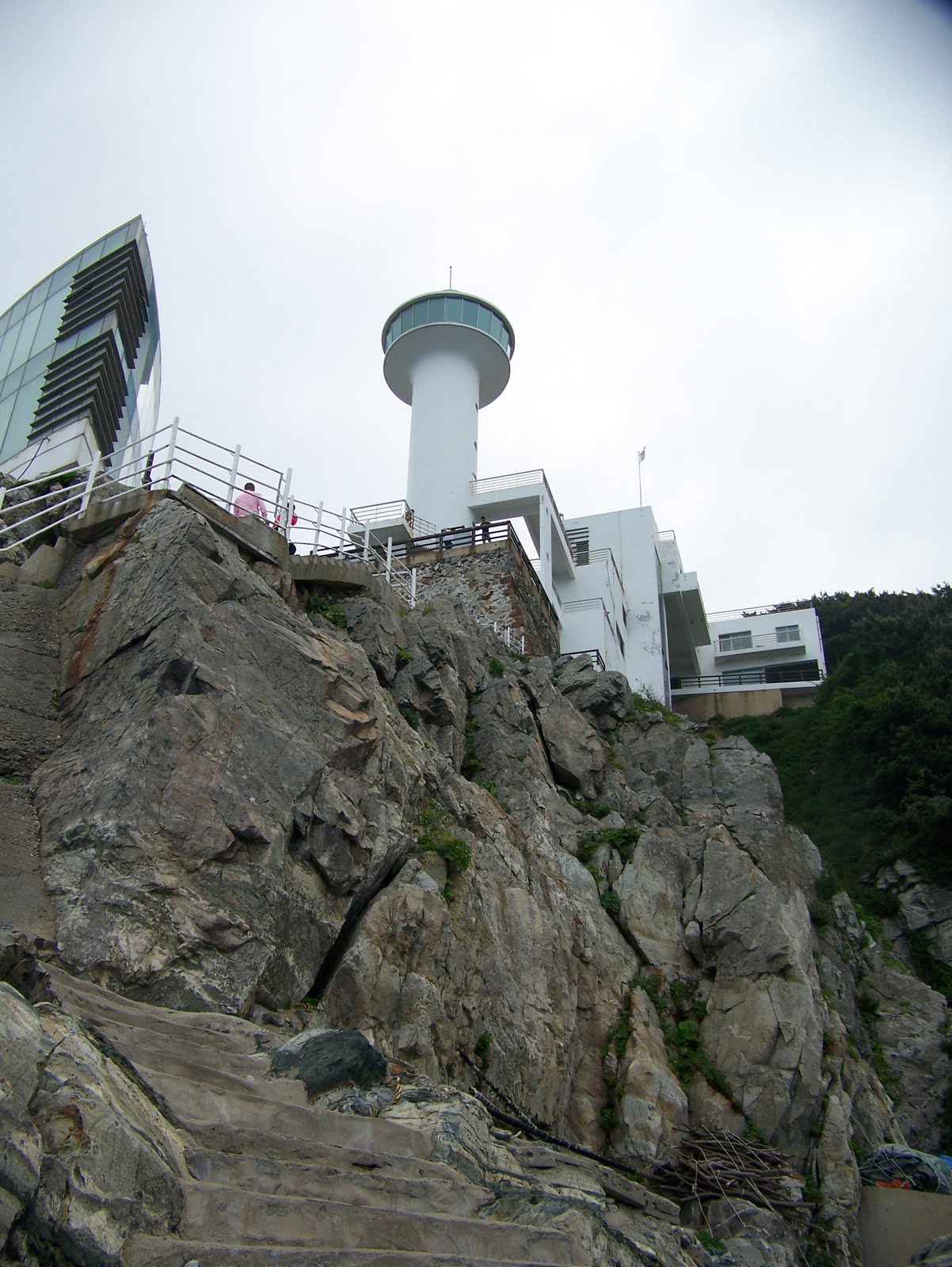
I cannot overstate how much we enjoyed their visit; and I cannot choose some moments over others as being "the best things" about those few day, so I will just say that one memorable activity of their stay was our trip to a raw seafood restaurant on the rocks below the lighthouse on Taejongdae Island.


 These views from the top and bottom of the cliffs give necessary perspective on what "seaside" dining really entails.


This was an experience that falls into the "first and only" category for us.  Donna had come up with the idea of taking Chloe and AhRa by subway and then taxi out to Taejongdae for seafood on the rocks, thinking the seafood would be cooked.  Of course.

We had seen the restaurants from an earlier trip to the lighthouse; but as the wind on that day was daunting, we had not ventured down to the rocks for a closer look. We knew the food would be fresh but we had somehow missed its "raw" aspect.


What had looked like cooking baskets and pots from two hundred feet up the cliff were really just holding tanks to keep the creatures alive.

It took only a few minutes for the girls to select sea squirt and sea cucumber from the tubs of salt water, and it took the cooks only a few minutes more to dispatch the creatures by chopping them into bite-size pieces and bring the delicacies in on a tray.


The darker, grey pieces are the sea cucumber and the rest is sea squirt, so far as I know.  The white food in the small dish is sliced radish with whole green peppers of the hot variety, and the other two dishes have hot sauces. Apart from the raw seafood, which is common enough in Busan but not the usual fare, and apart from the reduced number of small side-dish bowls, this is how a Korean meal is served.  You use your chopsticks to take from the main dish or dishes as well as from the side dishes.

There are many variations, of course, but we saw this basic format many times. I might add that this meal was unusual because we were not served kimchi, perhaps the only Korean meal we had during our four plus months without at least one bowl of kimchi.  Whether this had anything to do with the fact that we were at the seaside eating raw seafood, I don't know.


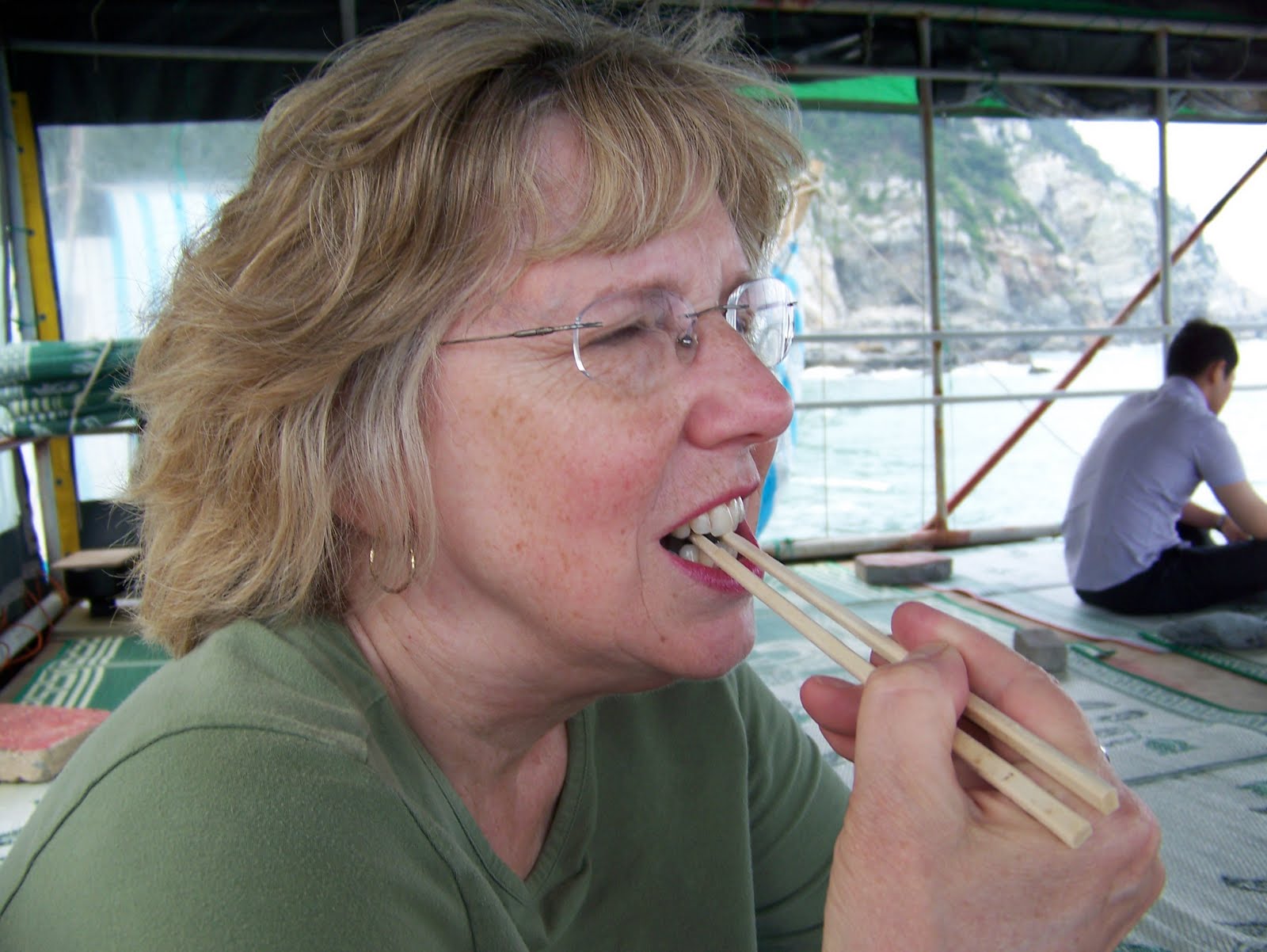
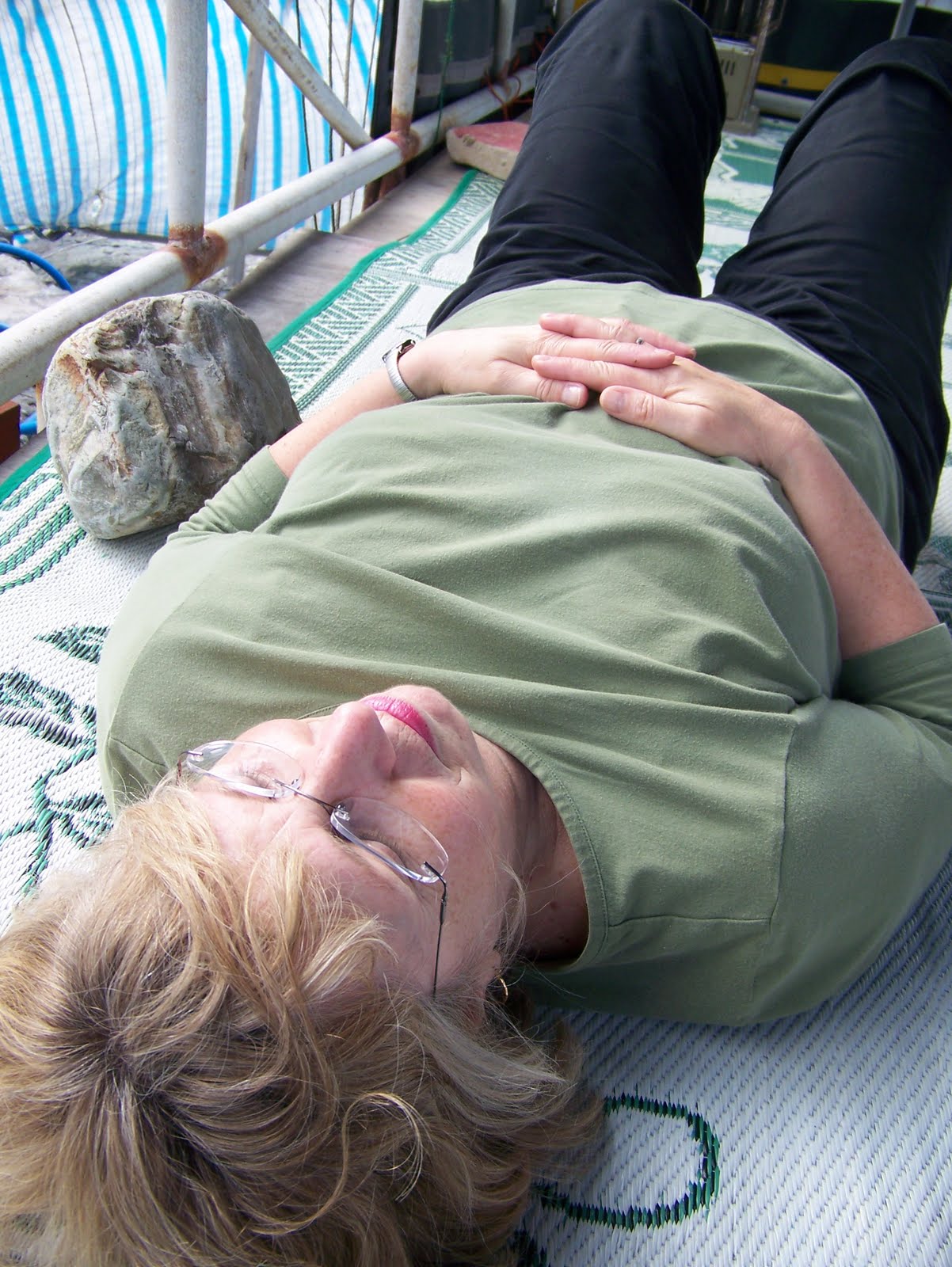
Our reactions to the seafood was predictably different from Chloe and AhRa's. Donna dutifully took a piece of sea cumcumber, found that it was nothing like the cucumber she was used to, and could not swallow it.  After that attempt, she needed a few minutes to recover.


I managed a piece of each and swallowed both, but decided I had done my duty and took no more.  For the record, neither cucumber nor squirt had a distinctive taste to me, being both somewhat bland by themselves.  The issue, I think, is with texture.  Sea cucumber is rubbery, rather more solid than it looked.  At least for my aging molars, it refused to break apart after serious grinding, and I eventually swallowed it whole.

The texture of the sea squirt was opposite the cucumber, being soft.  I expected it to disintegrate quickly, but it too resisted chewing.  Nothing would make it fragment, so again after rigorous chewing I swallowed the whole thing.


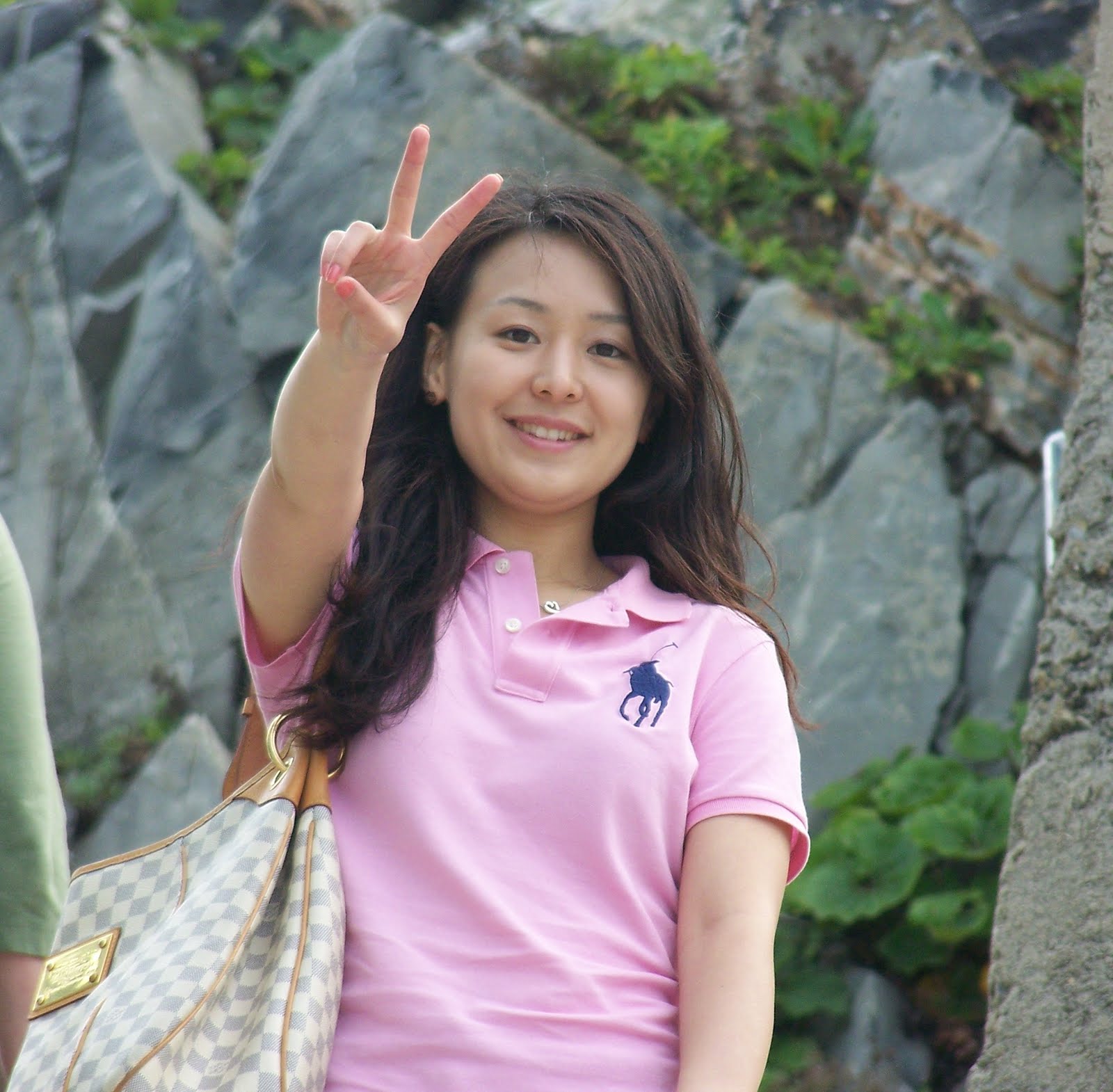
AhRa and Chloe found our efforts to eat quite amusing.  I did not get a usable picture of them laughing, but in this one their attention to the seafood we could not eat is clearly evident.

Eating was not all we did on this trip.  We watched the big ships coming and going outside of Busan Harbor,


and we hiked along the Taejongdae Island shore with its spectacular views.


But as was true everywhere we went in Korea -- and China, too -- it was people, in this case our remarkable and beautiful Korean daughters, who made the memorable truly unforgettable.


As I said earlier, our reasons for going to Korea were personal.

Wednesday, July 27, 2011

Busan Journal, End of the Dream -- Almost

Almost Home


We have been back in the US for nearly a month and home for a few days here and there, six days total.  The rest of the time we have been traveling, first in New England and now for the last week in Pennsylvania and Virginia.

During the few days we spent in Houghton unpacking and sorting and repacking, we have seen deer wander across our back yard.  The picture above was a near miss of twin fawns and their mother, who surprised us. I scrambled to get my camera. Mama deer had disappeared over the bank into the woods before I got the camera ready. 

Our time in New England was spent mostly in Maine, where the pictures below were taken.  Maine usually brings to mind pine forests and rocky coast lines, lobsters and sailing boats. These pictures are of a harbor just north of Kittery, Maine, where we had met our son Ian and his wife, Kristen, for lunch.


Yes, the sky and the water really are that blue.  And, yes, we smiled for the camera for those who like people in pictures.


My T-shirt reads "Wicked Big Sox Fan" just in case you can't read the tiny print. "Wicked" is characteristic New England adjective meant to intensify the noun that follows, after the manner of "very."  "Sox," of course, means the Boston Red Sox, a major league baseball team and a New England obsession. The "Sox fan" designation is crucial to clarify loyalties, especially since the New York license plates on our car might suggest "Yankee fan" instead.

I add here parenthetically that my wife claims to be a Yankee fan although she does not follow baseball.  Her loyalty can be traced to her father, who was a Yankee fan of the "rabid" sort, another American adjective that both intensifies and colors the noun that follows.  "Rabid" indicates not only close support of the favored team but also necessary hatred of its close rivals. Further explanation makes for interesting story-telling, but it tends to raise more questions than it answers.

Most of our time in Maine was not spent at seaside, however; it was spent at Whitney Pond, a small lake with few boats and at least two resident loons.


I do not have photographs of the loons handy as they are "shy" birds that are more at home swimming for food underwater than either flying or trying to walk on land.  Photographing them takes more patience than I have had to date, as they will appear suddenly on the surface of the water looking very duck-like and then disappear just as suddenly under the surface again.

The lake may look like Golden Pond, the idyllic lake from the movie, but it isn't. This photo was taken from the little beach just after the sun went down behind the trees.

A week later, the morning  I was packing the car to travel south to Virginia, this yearling wandered into the side yard to chew on a bush near me.


She waited for me to get my camera and snap a few pictures -- undisturbed by my movements -- before she wandered off to graze on other things.

Apart from the traveling since we have been home, and apart from sleep issues we will attribute to jet lag, our readjustment to American life has been seamless. We had the same sense of seamlessness (again, with jet-lag issues) in December when we returned home after four months in England.

I suppose this seamlessness is all to the good, but I do find it a little unsettling simply because our experiences overseas were so good, so positive.  I must say that I am determined not to let our travels, in Korea, especially, slip away too fast. 

For that reason, I will continue to keep this blog going a bit longer, if only to recount some of our experiences and impressions before time bleaches them away.